What Color Do Brown and Blue Make? Paint Mixing Guide
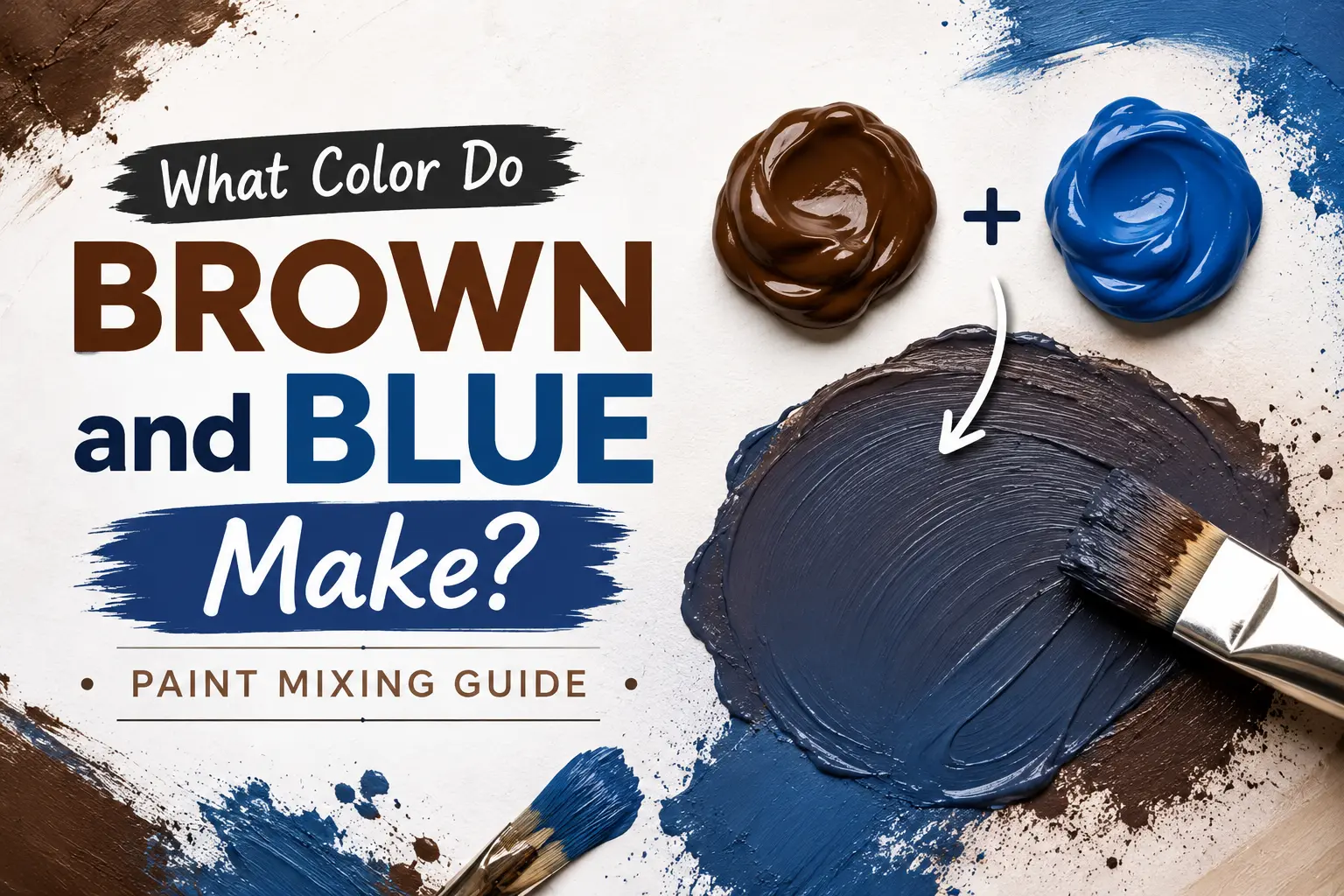
If you’ve ever wondered brown and blue make what color, you’re not alone.
Mixing brown and blue generally creates a dark, desaturated color like dark gray, slate, or a muted blue.
It isn’t always that simple because “brown” and “blue” aren’t just single pigments. They are made up of various underlying colors that react differently when combined. In this guide, you’ll learn how color science works here, how different ratios change the final hue, and how to use these mixes in your creative projects.
Main Takeaway:
Brown + Blue = Dark Gray / Slate (depending on the specific shades and ratios you use).
Quick Answer: What Do Brown and Blue Make When Mixed?
When you mix standard brown paint with standard blue paint, you’ll end up with a cool, neutralized color. This is usually a deep, smoky gray or a slate color.
This happens because brown is a warm composite color containing red, yellow, and blue, while blue is a cool primary color. When you bring them together, the blue cools down the warm brown, neutralizing its warmth.
To mix this yourself, simply squeeze out equal parts of a medium brown, like Burnt Sienna, and a medium blue, like Ultramarine. Blend them slowly with a palette knife on your palette.
Imagine you’re painting a moody, stormy sky. Instead of reaching for a pre-mixed black paint, you can combine cobalt blue and raw umber to get a beautiful, rich gray that looks incredibly lifelike.
Now let’s look at why these two colors behave this way on a deeper level.
Why Do Brown and Blue Make This Color?
Brown and blue neutralize each other because of how our eyes perceive color wavelengths. Brown is essentially a dark, muted orange.
Orange and blue sit directly opposite each other on the traditional color wheel, making them complementary colors. When complementary colors mix, they cancel each other’s intensity out and create neutral tones.
To see this in action, think of brown as a mixture of red and yellow (which makes orange) with a tiny splash of blue. When you add even more blue to that mix, you are balancing the warm reds and yellows with cool blue tones.
For instance, mixing a warm Burnt Umber (which is very orange-toned) with a cool Phthalo Blue instantly cancels out the bright blue punch, leaving you with a sophisticated dark gray.
Common Mistake: Beginners often try to make a dark gray by mixing black and white, which often looks flat and lifeless. Using brown and blue instead gives you a “living” dark gray with rich, natural undertones.
The reason is simple: physical pigments have unique characteristics. Let’s look at how changing the specific tube of paint you grab can completely alter your results.
What Happens When You Mix Different Shades of Brown and Blue?
Not all brown’s and blues are created equal. The specific undertones of the paints you choose will dramatically change your final mixture.
Some blues have green undertones, while some browns are highly reddish. These underlying pigments fight or cooperate with each other on the canvas.
If you mix a reddish-brown like Burnt Sienna with a warm blue like Ultramarine, you get a gorgeous, deep slate color. If you mix a dark, cool brown like Raw Umber with a cool Cerulean Blue, you’ll get a beautiful, misty muted blue.
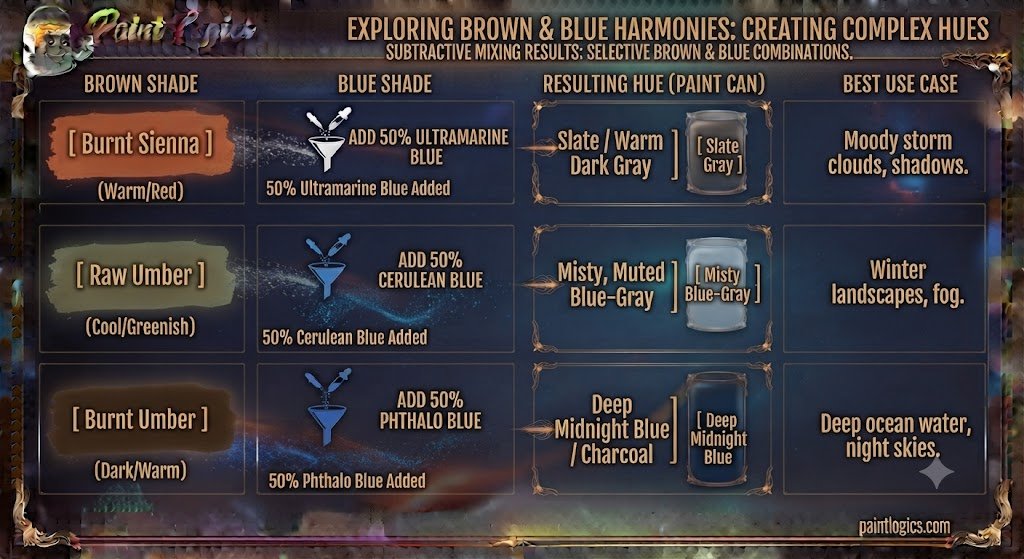
The table below breaks down these popular combinations:
| Brown Shade | Blue Shade | Resulting Hue | Best Use Case |
| Burnt Sienna (Warm/Red) | Ultramarine Blue (Warm/Red-undertone) | Slate / Warm Dark Gray | Moody storm clouds, shadows |
| Raw Umber (Cool/Greenish) | Cerulean Blue (Cool/Green-undertone) | Misty, Muted Blue-Gray | Winter landscapes, fog |
| Burnt Umber (Dark/Warm) | Phthalo Blue (Strong/Green-undertone) | Deep Midnight Blue / Charcoal | Deep ocean water, night skies |
Beside the shades themselves, the amount of each color you put on your brush makes a massive difference.
How the Ratio of Brown to Blue Affects the Final Color
The ratio of brown to blue acts as a sliding scale between warmth and coolness. You don’t have to settle for a single neutral gray.
Because blue is a highly dominant pigment (especially synthetic blues like Phthalo), a small amount can easily overpower a large amount of brown.
Adjusting your mixture requires a delicate touch. If you want a cool gray, you must add blue incrementally to your brown until it shifts.
Explanation:
Let’s look at how the balance tips depending on your ratios:
- More Brown than Blue: This creates a rich, earthy, cool brown or a “burnt” bronze shade. It’s perfect for painting tree bark in deep shadow.
- More Blue than Brown: This gives you a gorgeous, moody muted blue or denim color. It takes away the bright, plastic look of pure blue paint.
- Equal Parts: This is the sweet spot for a balanced, neutral dark gray.
Pro Tip: Always add your darker or stronger pigment (usually blue) to the lighter pigment (brown) in small increments. It is much easier to darken a light mix than to lighten a dark one.
To understand this mixing behavior on a deeper level, let’s explore how different color models explain this relationship.
Brown and Blue in Color Theory: RYB, RGB, and CMYK
Color behaves differently depending on whether you are mixing physical paint, working on a computer screen, or printing on paper.
Each medium uses a different color model to define how colors interact. We can look at how brown and blue interact across the three primary color models.
Let’s start with the classic model used by painters.
RYB (Red, Yellow, Blue) Color Model:
The RYB model is the traditional system used for physical paints and pigments.
In this model, blue is a primary color, and brown is a tertiary color made by mixing red, yellow, and blue (with more red and yellow).
When you mix them, you are essentially mixing all three primary colors together. This is why the result is always a neutralized, desaturated color like slate gray—all three primaries cancel each other out.
RGB (Red, Green, Blue) Color Model:
The RGB model is an additive light model used for digital screens like your phone or computer.
In this digital space, colors are made by adding light beams together instead of physical pigments. Brown is created digitally by combining red and green light at lower intensities.
Adding blue light to this digital brown shifts the pixels toward a cooler, desaturated blue-gray. Web designers use hex codes like #5A6A72 to render a beautiful slate gray by balancing red, green, and blue light values.
CMYK (Cyan, Magenta, Yellow, Black) Color Model:
CMYK is a subtractive color model used in color printing.
In printing, inks filter the light reflecting off the white paper. Printers create brown using a combination of cyan, magenta, and yellow.
Adding blue (or cyan) ink to this mix subtracts more light, pushing the printed image toward a deep, neutral dark gray or dark navy. Look closely at a printed color photo of a dark winter coat; it is often made of tiny cyan and brown dots layered together.
Now that we know how they interact on their own, what happens when we introduce a third color to our blue and brown mix?
Mixing Brown and Blue with Other Colors
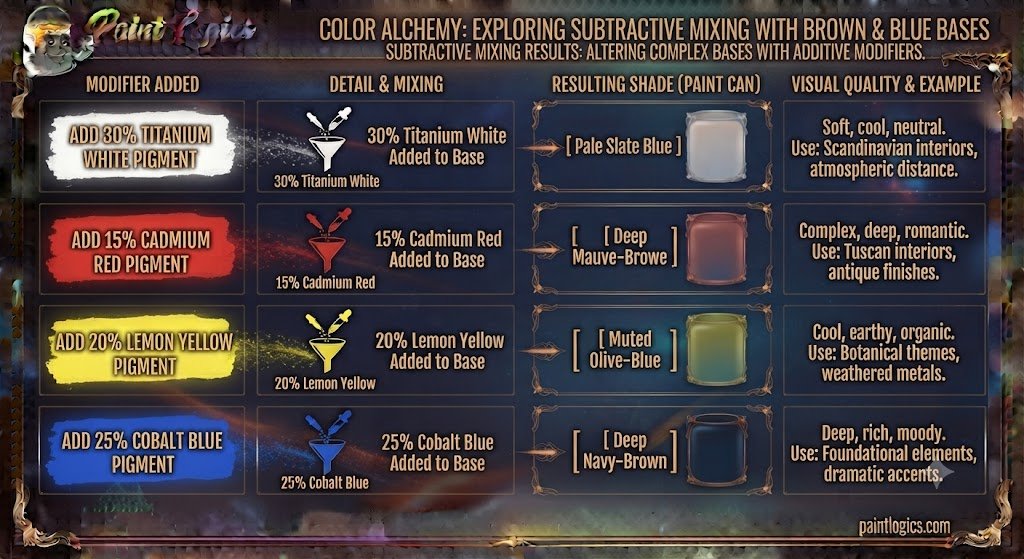
You can create entirely new color palettes by adding a third pigment to your brown and blue mixture.
A third color pulls the neutral gray or slate into entirely new color families. Let’s look at what happens when we stir in some common studio paint colors.
First, let’s see what yellow does to this cool combination.
Brown + Blue + Yellow
Adding yellow to your brown and blue mixture pulls the color toward the green family.
Since blue and yellow make green, and brown has yellow undertones, adding pure yellow highlights the green qualities of the mix.
Mix equal parts brown and blue, then slowly add a warm yellow like Yellow Ochre. This results in a beautiful, earthy olive green or army green, ideal for landscape painters painting moss or forest floors.
Brown + Blue + Green
Introducing green to brown and blue creates a very rich, cool, natural hue.
Green reinforces the cool tones of the blue while harmonizing with the organic earthiness of the brown.
Add a touch of Viridian Green to your slate gray mixture. You’ll get a deep, forest-floor teal or a dark pine green that looks incredibly organic.
Brown + Blue + White
Adding white is the easiest way to reveal the hidden undertones of your brown and blue mix.
White increases the value (lightness) of the mix without changing its color temperature.
Take your dark slate gray and mix in a dab of Titanium White. You will instantly see a gorgeous, soft slate blue or a cool pastel gray that is highly sought after in modern home decor.
Brown + Blue + Red
Adding red introduces a rich, warm element to your neutral mix.
Red fights against the cooling effect of the blue, bringing back a warm, plum-like complexity.
Mix a touch of Cadmium Red into your deep brown-blue slate. You will end up with a beautiful, dusty plum or a muted, deep eggplant purple.
With all these mixing possibilities, how can we apply this color combination to real-world creative projects?
Artistic Uses of Brown and Blue Together
Brown and blue are a classic design pairing because they perfectly balance warmth and coolness, representing earth and sky.
This natural contrast feels incredibly balanced and comforting to the human eye. Let’s look at how three different creative industries utilize this powerful combination.

Let’s start with fine arts.
In Art:
Landscape painters rely heavily on brown and blue to create atmospheric perspective.
Pure black paint can look flat and unnatural on a canvas. Artists mix Ultramarine Blue and Burnt Umber to create deep shadows, stormy skies, and realistic rocks.
Think of a painting of a foggy mountain range; those misty, distant peaks are almost always painted using washes of brown and blue.
In Fashion:
In clothing, brown and blue create a highly sophisticated, classic look.
The cool crispness of blue tempers the rustic, casual nature of brown. Fashion designers often pair these colors to create professional yet approachable outfits.
Think of a sharp navy blue suit paired with rich cognac leather shoes and a matching brown leather belt. It looks instantly polished.
In Interior Design:
Interior designers use brown and blue to create spaces that feel cozy yet airy.
This combination mimics the natural world, bringing a sense of calm indoors. Designers pair warm wooden furniture (brown) with cool slate blue accent walls or textiles.
Imagine a living room with a chocolate-brown leather sofa, decorated with soft slate blue throw pillows and a cream rug. It is a timeless, inviting look.
Now that you know the secrets behind this classic pairing, you’re ready to start mixing with confidence.
Conclusion
So, brown and blue make what color? The quick answer is that they mix to create a beautiful, versatile dark gray, slate, or muted blue.
The exact shade you get depends entirely on the specific paint tubes you select and the ratios you use. You don’t have to worry about ending up with a muddy, unusable mess.
Grab your palette and experiment with different ratios of Burnt Sienna and Ultramarine Blue. Add a touch of white to see those beautiful, hidden undertones.
Final Takeaway: Don’t fear the mix! Embracing physical paint mixing with brown and blue will give your artwork, interior designs, or crafts a depth and sophistication that pre-mixed colors can never match.
Love To Read More: What Color Do Red and Pink Make? Mixing Guide
FAQs – Brown and Blue Color Mixing
What color does brown and blue make when mixed?
When mixed together, brown and blue make a neutral dark color, typically ranging from a smoky dark gray to a dusty slate or muted blue. This happens because the warm orange undertones in brown neutralize the cool tones of the blue.
Can brown and blue make vibrant colors?
No, they generally cannot make vibrant colors on their own. Because brown and blue act as near-complements on the color wheel, they naturally cancel out each other’s intensity, resulting in beautifully muted, earthy, or desaturated tones rather than bright ones.
How does adding white affect brown and blue?
Adding white to a brown and blue mixture lightens the value, turning a dark, heavy gray into a soft slate blue or a cool pastel gray. This is a fantastic way to reveal the subtle, hidden undertones of your mixture.
What happens when I mix brown, blue, and yellow?
When you mix brown, blue, and yellow, you will end up with an organic, earthy green, such as olive green or army green. The blue and yellow combine to make green, while the brown keeps the overall tone very natural and grounded.
Can I use brown and blue to create a dark color?
Absolutely. In fact, mixing a dark brown (like Burnt Umber) with a deep blue (like Phthalo Blue) is a favorite trick of professional artists to create a rich, deep near-black. It looks much richer and more realistic than using black paint straight from the tube.
What are good complementary colors for brown and blue?
Since brown and blue are already near-complements, they pair wonderfully with warm metallic accents like gold, brass, or copper. Terracotta, soft peach, and warm cream also look spectacular when styled alongside brown and blue.
Can I use brown and blue together in interior design?
Yes, this is an incredibly popular and timeless design combination. Pairing warm brown tones (like walnut or oak wood) with cool blue accents (like navy or slate) creates a balanced, comforting, and sophisticated atmosphere in any room.
What happens when I mix brown, blue, and green?
Mixing brown, blue, and green creates a deep, earthy forest green or a cool, dark pine color. The green harmonizes with both the cool blue and the organic brown, making it perfect for painting natural landscapes.
How do I make brown and blue lighter?
The best way to make your brown and blue mixture lighter is by adding small dabs of white paint. If you want to lighten it while keeping it warm, you can also add a touch of light yellow or cream paint.
Is brown and blue a good color combination for fashion?
Yes, it is a classic fashion pairing. The combination of a navy blue garment with cognac or chocolate brown leather accessories is highly regarded because it balances cool professionalism with warm, earthy comfort.
What color does brown, blue, and red make?
Mixing brown, blue, and red creates a deep, dusty plum or a muted eggplant purple. The red adds a warm, reddish-purple hue to the cool, neutralized brown-blue base.
Can I mix brown and blue to create a purple tone?
You can, but it will be a very muted, smoky purple. To achieve this, you need to use a reddish-brown (like Burnt Sienna) and a warm blue with red undertones (like Ultramarine). Adding a tiny touch of red paint will help make the purple tone much more noticeable.