26 Colors That Start With O: Names, Hex Codes & Meanings
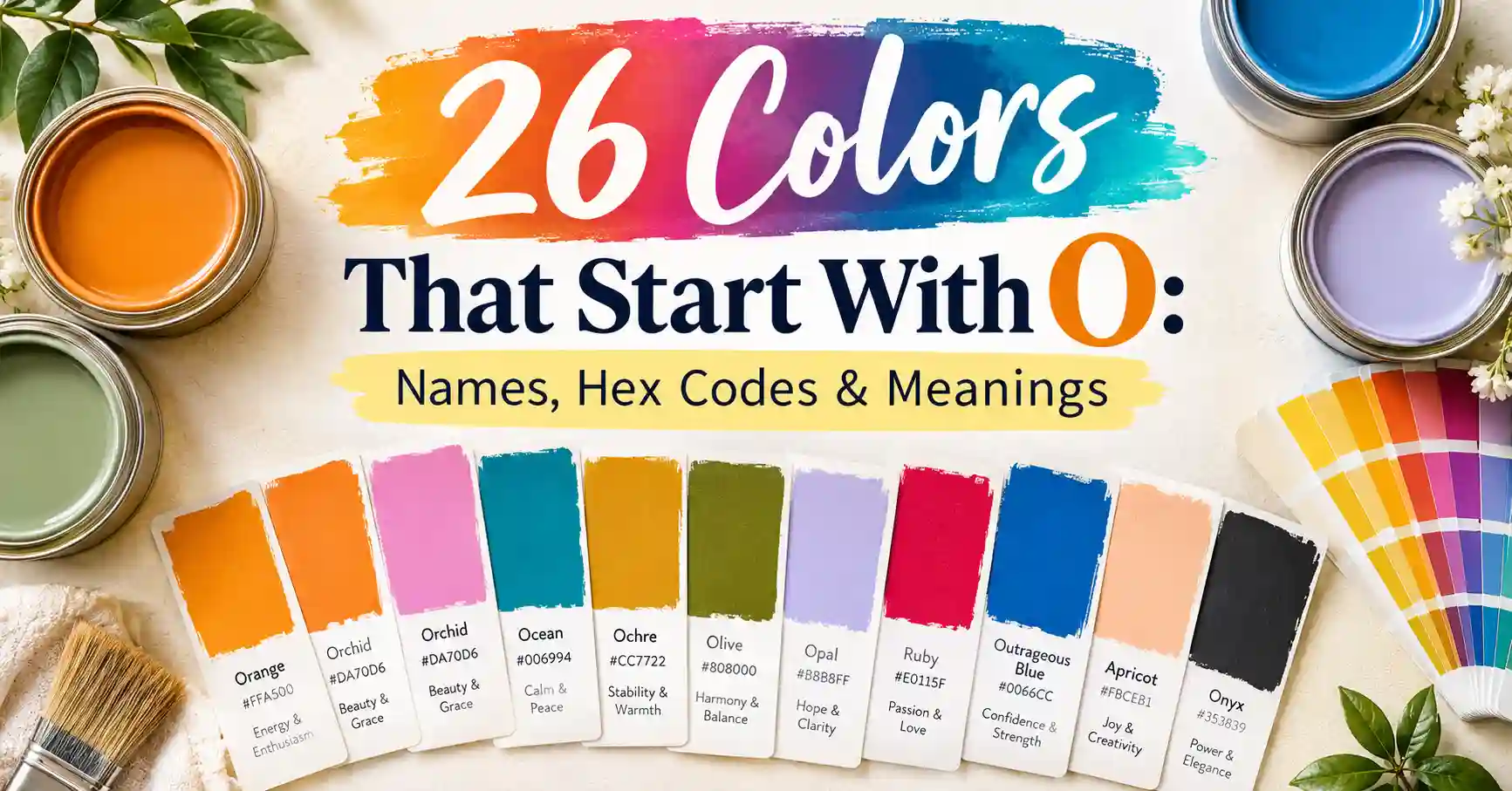
If you’ve ever described a color as “olive,” “ochre,” or “onyx,” you’ve already used some of the best-known colors that start with O. This guide lists 26 real names, and every one has a code you can trust. Each entry includes the name, Hex, RGB, and CMYK values.
Many of these names come from gemstones, fruit, and old pigments. Others come from fabrics and the web color standard. Together they cover warm oranges, dusty purples, deep greens, and near-black darks.
The CMYK numbers are approximate screen-to-print conversions. Use them as a starting point, then check a printed proof.
Quick Jump Guide
These color names that start with O fall into six families: oranges and golds, reds and browns, pinks and purples, greens, blues, and neutrals. Oranges lead the list with seven entries. Nearly every family has at least one “Old” shade with a soft, aged look.
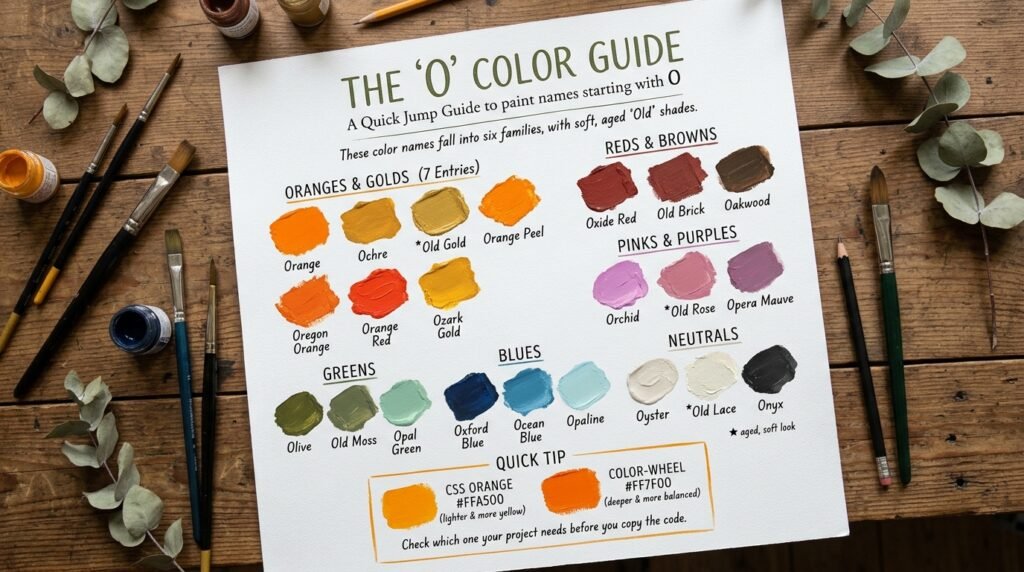
Quick Tip: Orange has two common versions. The CSS keyword (#FFA500) is lighter and more yellow. The color-wheel orange (#FF7F00) is deeper and more balanced. Check which one your project needs before you copy the code.
The Full List of Colors That Start With O
Ochre
Warm and earthy, this golden orange-brown looks like sun-baked clay. The name comes from the natural pigment made of clay and iron oxide, and it runs browner than Old Gold.
Hex: #CC7722 | RGB: 204, 119, 34 | CMYK: 0, 42, 83, 20
Office Green
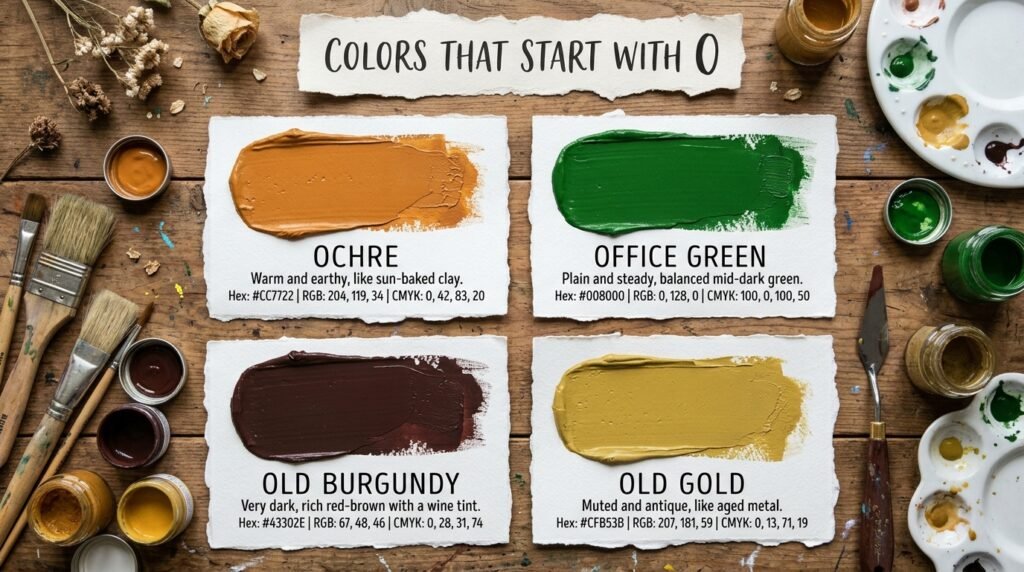
Plain and steady, this is a balanced mid-dark green with no yellow or blue pull. It matches the standard CSS green, and it looks cleaner than Olive.
Hex: #008000 | RGB: 0, 128, 0 | CMYK: 100, 0, 100, 50
Old Burgundy
Very dark and rich, this red-brown is close to black chocolate. It carries a faint wine tint, and it feels softer than Oxblood.
Hex: #43302E | RGB: 67, 48, 46 | CMYK: 0, 28, 31, 74
Old Gold
Muted and antique, this yellow-gold looks like aged metal. It’s less orange than Ochre and far calmer than Orange Peel.
Hex: #CFB53B | RGB: 207, 181, 59 | CMYK: 0, 13, 71, 19
Old Heliotrope
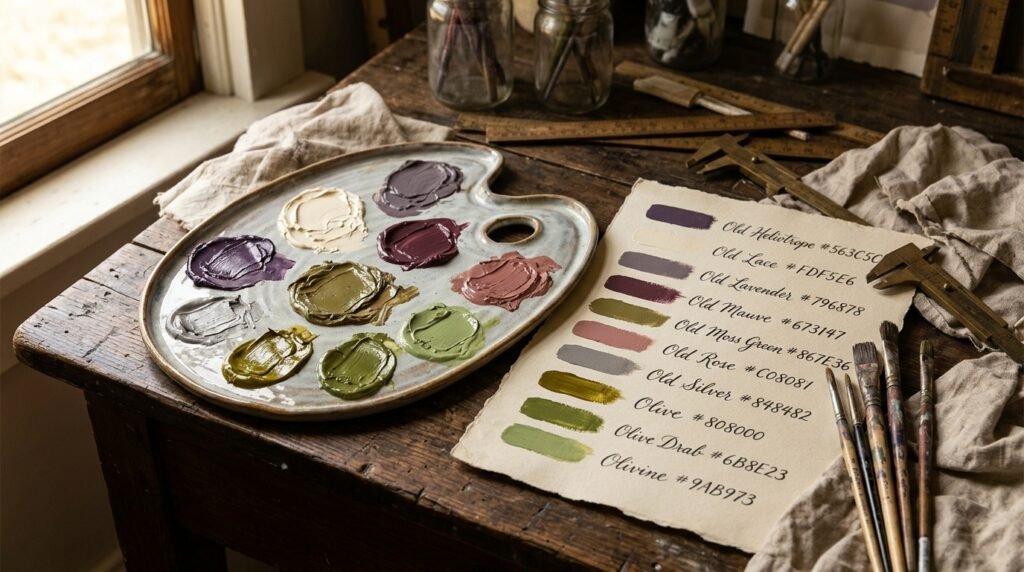
Dark and dusty, this is a deep plum-purple with a gray edge. It sits between Old Lavender and Old Mauve in weight.
Hex: #563C5C | RGB: 86, 60, 92 | CMYK: 7, 35, 0, 64
Old Lace
Soft and warm, this cream-white recalls aged lace. It feels cozier than a stark white and barely tints toward peach.
Hex: #FDF5E6 | RGB: 253, 245, 230 | CMYK: 0, 3, 9, 1
Old Lavender
Muted and calm, this gray-purple has a smoky, faded look. It’s lighter than Old Heliotrope and much quieter than Orchid.
Hex: #796878 | RGB: 121, 104, 120 | CMYK: 0, 14, 1, 53
Old Mauve
Deep and wine-like, this plum-red has real weight. It’s darker and richer than Old Rose.
Hex: #673147 | RGB: 103, 49, 71 | CMYK: 0, 52, 31, 60
Old Moss Green
Earthy and dark, this yellow-leaning green looks like shaded forest moss. It’s close to Olive but a bit browner and deeper.
Hex: #867E36 | RGB: 134, 126, 54 | CMYK: 0, 6, 60, 47
Old Rose
Dusty and gentle, this pink carries a brown-gray tint. It feels vintage and romantic, and it’s far softer than Orchid.
Hex: #C08081 | RGB: 192, 128, 129 | CMYK: 0, 33, 33, 25
Old Silver
Neutral and calm, this mid-dark gray has a faint warm tone. It looks less shiny than its name suggests.
Hex: #848482 | RGB: 132, 132, 130 | CMYK: 0, 0, 2, 48
Olive
Deep and earthy, this dark yellow-green is named after the olive fruit and tree. It’s yellower and more muted than Office Green.
Hex: #808000 | RGB: 128, 128, 0 | CMYK: 0, 0, 100, 50
Olive Drab
Dull and dependable, this green has a brown-yellow tint. It leans greener and brighter than Olive, and it looks right at home on rugged gear.
Hex: #6B8E23 | RGB: 107, 142, 35 | CMYK: 25, 0, 75, 44
Olivine
Fresh and soft, this pale yellow-green is named after the gem-quality mineral. It looks lighter and friendlier than Olive Drab.
Hex: #9AB973 | RGB: 154, 185, 115 | CMYK: 17, 0, 38, 27
Onyx
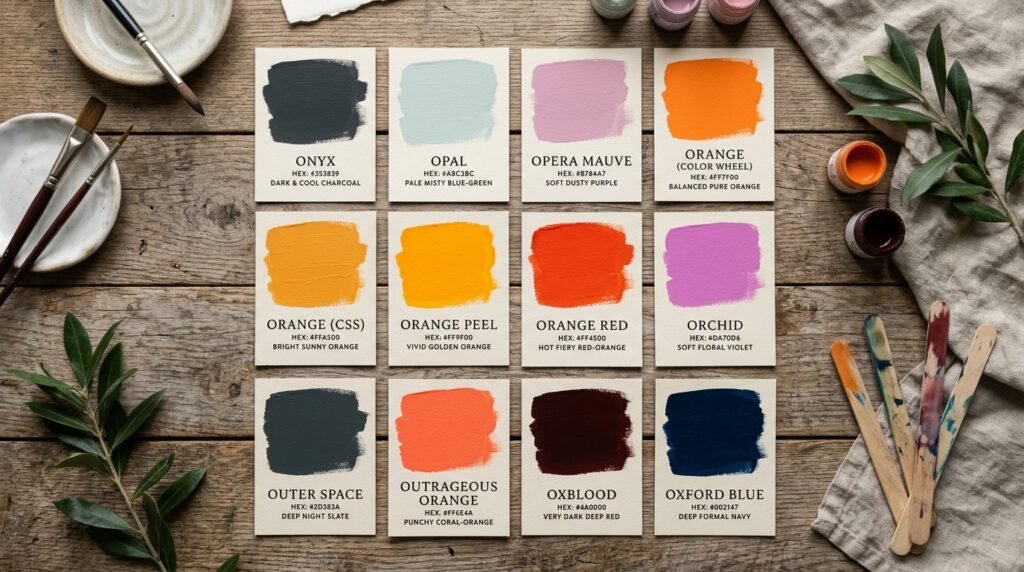
Dark and cool, this charcoal leans slightly blue-gray and isn’t pure black. It’s named after the dark gemstone, and it’s the darkest color in the list.
Hex: #353839 | RGB: 53, 56, 57 | CMYK: 7, 2, 0, 78
Opal
Pale and misty, this blue-green gray feels calm and airy. It’s named after the milky gemstone, and it’s much lighter than Oxford Blue.
Hex: #A8C3BC | RGB: 168, 195, 188 | CMYK: 14, 0, 4, 24
Opera Mauve
Soft and dusty, this pinkish purple has a gentle, vintage feel. It looks warmer than Old Lavender and lighter than Old Mauve.
Hex: #B784A7 | RGB: 183, 132, 167 | CMYK: 0, 28, 9, 28
Orange (Color Wheel)
Balanced and pure, this orange sits halfway between red and yellow. It’s deeper and more red than the CSS version below.
Hex: #FF7F00 | RGB: 255, 127, 0 | CMYK: 0, 50, 100, 0
Orange (CSS)
Bright and sunny, this orange leans toward yellow. It’s the official web keyword, and it looks lighter than Orange (Color Wheel).
Hex: #FFA500 | RGB: 255, 165, 0 | CMYK: 0, 35, 100, 0
Orange Peel
Vivid and golden, this orange is named after the fruit’s skin. It’s a touch yellower than Orange (Color Wheel) and very close to Orange (CSS).
Hex: #FF9F00 | RGB: 255, 159, 0 | CMYK: 0, 38, 100, 0
Orange Red
Hot and fiery, this orange leans strongly toward red. It looks bolder and more urgent than Orange Peel.
Hex: #FF4500 | RGB: 255, 69, 0 | CMYK: 0, 73, 100, 0
Orchid
Soft and floral, this violet-pink is named after the flower. It’s lighter and brighter than Old Lavender.
Hex: #DA70D6 | RGB: 218, 112, 214 | CMYK: 0, 49, 2, 15
Outer Space
Deep and cool, this slate is a dark blue-gray with a night-sky feel. It looks very close to Onyx but a little bluer.
Hex: #2D383A | RGB: 45, 56, 58 | CMYK: 22, 3, 0, 77
Outrageous Orange
Punchy and loud, this coral-orange has a clear red lean. It looks hotter than Orange Peel and more playful than Orange Red.
Hex: #FF6E4A | RGB: 255, 110, 74 | CMYK: 0, 57, 71, 0
Oxblood
Very dark and serious, this deep red is nearly black. It’s much darker than Old Mauve and has no purple in it.
Hex: #4A0000 | RGB: 74, 0, 0 | CMYK: 0, 100, 100, 71
Oxford Blue
Deep and formal, this navy sits close to black. It’s tied to Oxford University, and it looks far darker than Opal.
Hex: #002147 | RGB: 0, 33, 71 | CMYK: 100, 54, 0, 72
Colors That Start With O, Grouped by Family
This table sorts every entry into six broad families. Use it when you know the mood you want but not the exact name yet.
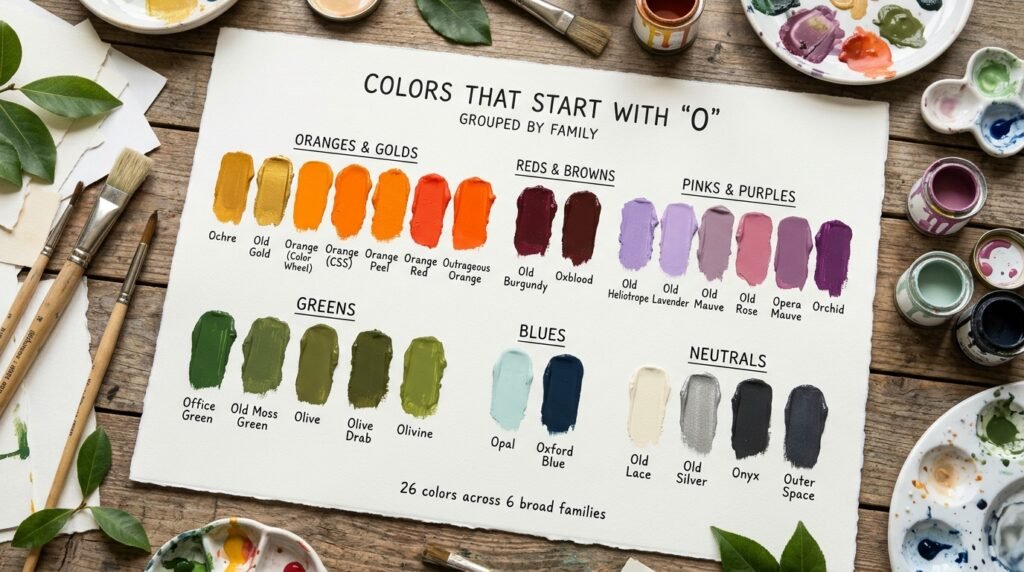
| Family | Colors |
| Oranges & Golds | Ochre, Old Gold, Orange (Color Wheel), Orange (CSS), Orange Peel, Orange Red, Outrageous Orange |
| Reds & Browns | Old Burgundy, Oxblood |
| Pinks & Purples | Old Heliotrope, Old Lavender, Old Mauve, Old Rose, Opera Mauve, Orchid |
| Greens | Office Green, Old Moss Green, Olive, Olive Drab, Olivine |
| Blues | Opal, Oxford Blue |
| Neutrals | Old Lace, Old Silver, Onyx, Outer Space |
The table holds 26 colors. Oranges are the biggest family with seven entries, and pinks and purples follow with six. Blues have just two, which makes both easy to remember.
How to Read Hex, RGB, and CMYK Codes
Hex, RGB, and CMYK describe the same color in three ways. Each fits a different job.

Hex is a six-digit code, like #002147. It’s the standard for websites and design apps. Paste it into CSS or Figma, and you’re done.
RGB splits a color into red, green, and blue light. Each value runs from 0 to 255. Use it when a tool shows sliders instead of a code box.
CMYK describes ink, not light. It stands for cyan, magenta, yellow, and black (K). Printers ask for it. The rule is simple: screens use Hex or RGB, and print uses CMYK.
How to Use These Colors
Graphic design. Pair Oxford Blue (#002147) with Old Gold (#CFB53B) for a classic, formal poster. The dark navy anchors the page, and the gold adds a rich accent.
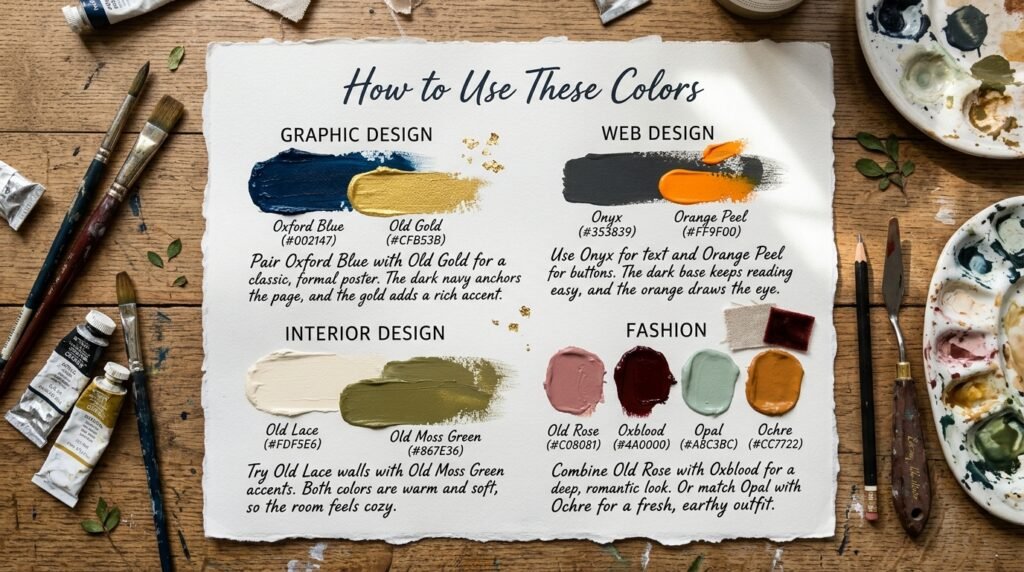
Web design. Use Onyx (#353839) for text and Orange Peel (#FF9F00) for buttons. The dark base keeps reading easy, and the orange draws the eye.
Interior design. Try Old Lace (#FDF5E6) walls with Old Moss Green (#867E36) accents. Both colors are warm and soft, so the room feels cozy.
Fashion. Combine Old Rose (#C08081) with Oxblood (#4A0000) for a deep, romantic look. Or match Opal (#A8C3BC) with Ochre (#CC7722) for a fresh, earthy outfit.
Conclusion
Colors that start with O cover a wide range, from bright oranges to deep, near-black darks. You get dusty “Old” shades, fresh greens, gemstone tones, and bold, punchy hues. All 26 names here have verified codes you can trust. Explore our color tool to test these shades together before you lock in a palette.
FAQs
What are some colors that start with O?
The best-known are Orange, Olive, Orchid, Onyx, and Ochre. Oxford Blue and Old Rose add more refined options.
What is the darkest color that starts with O?
Onyx (#353839) is the darkest, with a CMYK black value of 78. Outer Space (#2D383A) comes very close at 77.
What is the brightest color that starts with O?
Orange (Color Wheel) (#FF7F00) and Orange Peel (#FF9F00) are the most vivid, since both carry full yellow in CMYK. Orange Red (#FF4500) is the hottest.
What is the difference between the two oranges?
Orange (CSS) (#FFA500) is lighter and more yellow. Orange (Color Wheel) (#FF7F00) is deeper and sits evenly between red and yellow.
What is the difference between Olive and Olive Drab?
Olive (#808000) is a dark, yellow-leaning green. Olive Drab (#6B8E23) is greener and brighter, with a duller, rugged feel.
What does “Old” mean in color names like Old Rose?
It often hints at a softer, aged look. Old Rose (#C08081) is a dusty pink, and Old Gold (#CFB53B) is a muted, antique gold.
Why do some sites show different codes for Oxblood or Onyx?
Traditional names have no single official code, so each site picks its own shade. We use the most widely cited values: #4A0000 for Oxblood and #353839 for Onyx. Always confirm the code before you print.