What Colors Make Black? How to Mix Paint Step by Step
Ever stared at your palette wondering what colors make black, only to end up with a muddy brown instead? You’re not alone. Black feels like it should be simple. It isn’t, at least not with paint.
Main takeaway: Mix Ultramarine Blue and Burnt Sienna in roughly equal parts. That single pairing gets you closer to a true, rich black than almost any other combination. Add a touch more blue for a cooler black. Add more sienna for a warmer one.
This guide walks through exactly how to make black paint, why store-bought black often falls flat next to a hand-mixed one, and how to fine-tune your result until it’s exactly the shade you need.
What Is Black?
Black isn’t technically a color on the visible spectrum. It’s the total absence of reflected light. That’s the science. In practice, though, painters treat black as a color, and a genuinely useful one.
Black sits outside the traditional color wheel. It has no hue, no warmth, no coolness on its own. But mixed black almost always leans one way or another. A blue-heavy black reads cool. A brown-heavy black reads warm.
Black carries strong associations. It suggests elegance, mystery, power, and formality. In design work, it’s the anchor color that makes everything else pop. In fashion, it’s the safest, most versatile shade in any closet.
What Colors Make Black?
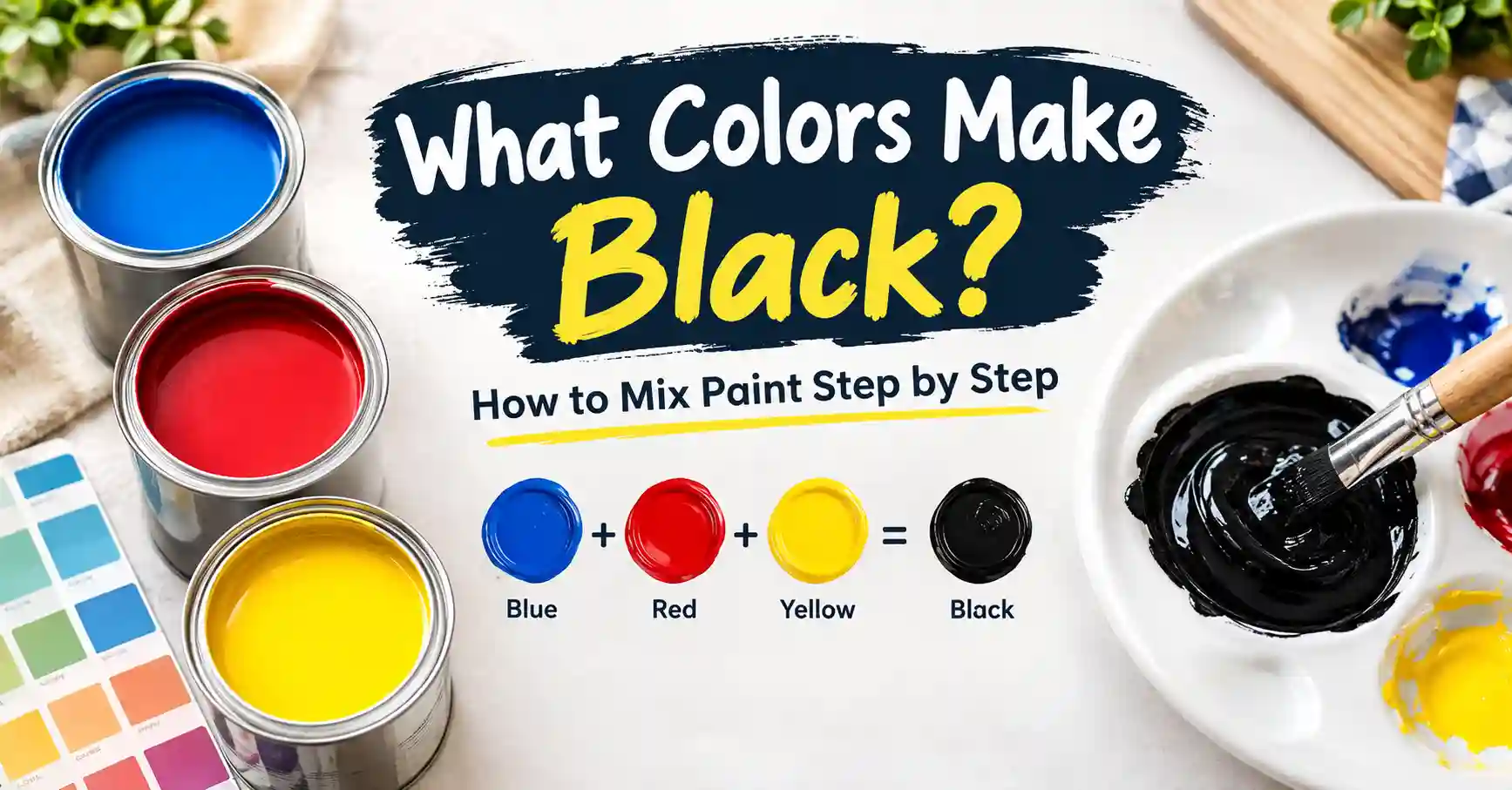
So, what colors make black when you’re standing at a palette with tubes of paint? The short answer: complementary colors mixed together.
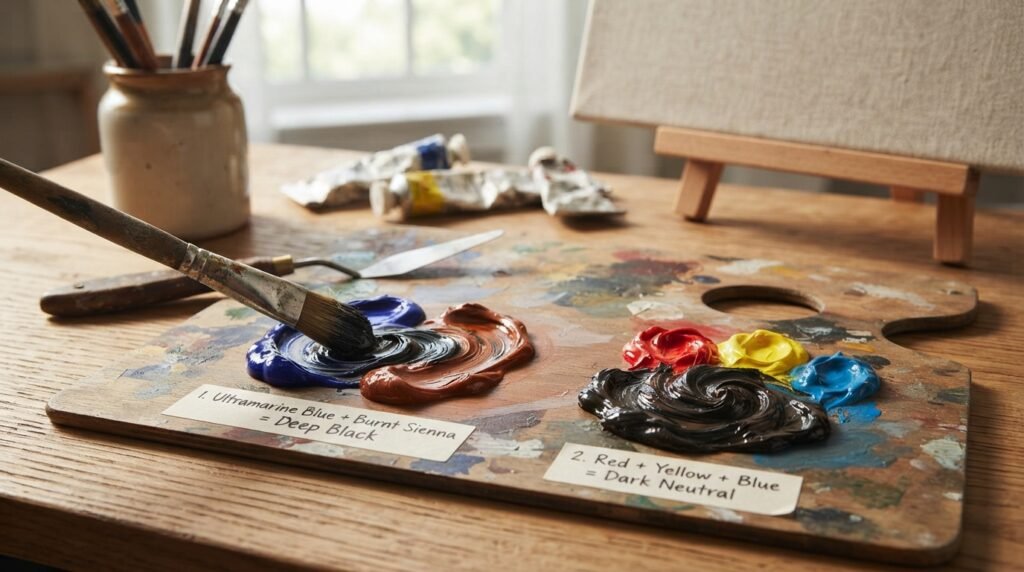
Complementary colors sit opposite each other on the color wheel. When you combine them, they cancel out each other’s hue and produce a neutral, dark tone. Push that mixing far enough, and you land on black or something extremely close to it.
The most reliable combination is Ultramarine Blue + Burnt Sienna, mixed roughly 1:1. Ultramarine is a cool, deep blue. Burnt Sienna is a warm, reddish-brown. Together, they neutralize each other almost completely.
Another dependable path: mix all three primary colors. Red + Yellow + Blue, combined in roughly equal parts, produces a dark, muddy near-black. It’s slightly less clean than the Ultramarine-Sienna method, but it works in a pinch.
Image caption: Swatch strip showing Ultramarine Blue and Burnt Sienna gradually mixing into a deep, near-black tone.
Step-by-Step: How to Mix Black in Paint
Here’s exactly how to make black paint from scratch, whether you’re working in acrylic, oil, or gouache.
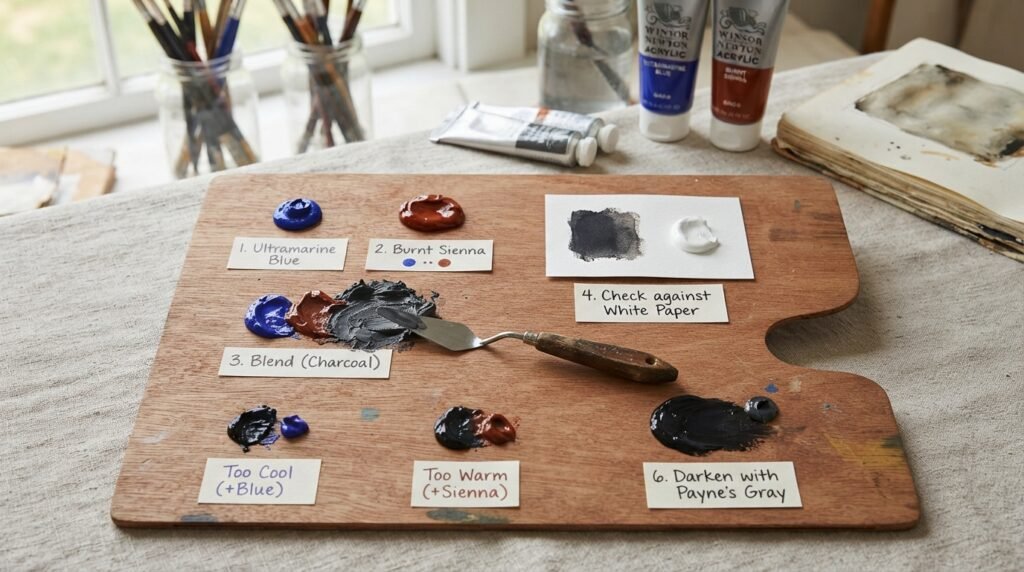
- Start with a small amount of Ultramarine Blue on your palette. A dime-sized dab is plenty for testing.
- Add an equal amount of Burnt Sienna. Don’t mix yet. Just place it next to the blue.
- Blend the two together slowly, using a palette knife or brush. Watch the color shift from muddy purple-brown toward deep charcoal.
- Check the result against white paper. True black looks almost gray next to pure white paint, which is normal.
- Adjust for warmth or coolness. Too warm? Add a touch more Ultramarine. Too cool or flat? Add a touch more Burnt Sienna.
- Darken further if needed with a tiny amount of Payne’s Gray or a commercial black, used sparingly as a booster rather than the main ingredient.
- Test dry. Paint always looks darker wet than dry. Let a small sample dry fully before judging the final shade.
Beginner Tip: Always mix more black than you think you’ll need. It’s one of the hardest colors to match exactly twice, and running out mid-painting means starting the whole process over.
Mixing Chart: Paint Combinations for Black
Different pigment pairs produce slightly different blacks, some warmer, some cooler, some with a subtle color cast that only shows up in direct sunlight. The chart below shows ten combinations worth knowing, along with the rough hex code each one lands closest to.
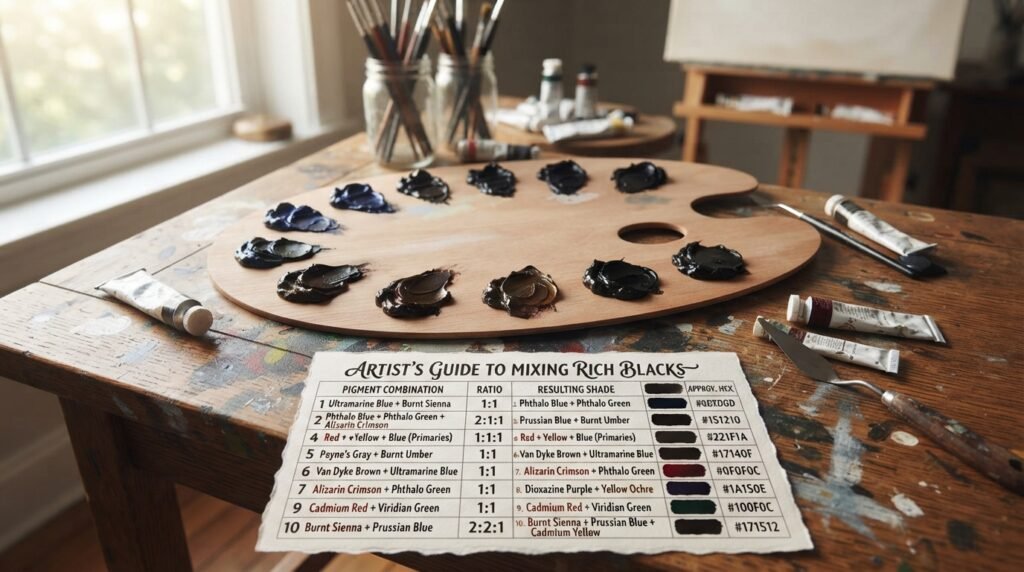
Use this table as a starting reference, not a strict rulebook. Paint brands vary, and pigment strength varies even more, so treat these ratios as a launchpad for your own testing.
| Pigment Combination | Ratio | Resulting Shade | Approx. Hex |
| Ultramarine Blue + Burnt Sienna | 1:1 | Rich mixing black | #1C1B18 |
| Phthalo Blue + Phthalo Green + Alizarin Crimson | 2:1:1 | Cool, deep black | #0D0D0D |
| Prussian Blue + Burnt Umber | 1:1 | Warm black | #151210 |
| Red + Yellow + Blue (primaries) | 1:1:1 | Muddy near-black | #221F1A |
| Payne’s Gray + Burnt Umber | 1:1 | Soft, muted black | #1B1A17 |
| Van Dyke Brown + Ultramarine Blue | 1:1 | Deep, warm-leaning black | #17140F |
| Alizarin Crimson + Phthalo Green | 1:1 | True complementary black | #0F0F0C |
| Dioxazine Purple + Yellow Ochre | 1:1 | Warm, earthy black | #1A150E |
| Cadmium Red + Viridian Green | 1:1 | Deep black with green undertone | #100F0C |
| Burnt Sienna + Prussian Blue + touch of Cadmium Yellow | 2:2:1 | Balanced, neutral black | #171512 |
Notice how none of these hit pure #000000. That’s expected and even desirable. A completely flat, lifeless black rarely appears in nature or in good painting. The slight variation in each mix is what gives hand-mixed black its depth.
How to Make Black With Different Starting Colors
Not everyone has Ultramarine Blue and Burnt Sienna sitting on their palette. Here’s how to make black paint using whatever primaries you already own.
If you only have basic red, yellow, and blue paint, start there. Mix all three in equal parts. The result will look more like a dark, muddy brown than a true black at first. Keep adding small amounts of blue until it deepens.
If you have a warm and cool version of each primary, use the cool ones. Cool red (like Alizarin Crimson) plus cool yellow (like Lemon Yellow) plus cool blue (like Phthalo Blue) gets you closer to a true, neutral black than warm primaries would.
If you’re working with a limited student-grade set, try mixing your darkest blue with your darkest brown first. Most beginner sets include something close to Burnt Umber and Ultramarine, even under different names, so check your tube labels before assuming you’re missing pigments.
How to Make Black Digitally (RGB/Hex)
Digital black skips all the pigment guesswork. What colors make black on a screen comes down to a single, exact value.

The hex code for pure black is #000000. In RGB, that’s 0, 0, 0, meaning zero red, zero green, and zero blue light. No mixing ratios, no warm-or-cool adjustments needed.
In Photoshop, type 000000 directly into the hex field of the color picker, or set R, G, and B sliders all to 0. In Procreate, tap the color wheel and drag the selector to the very bottom corner, or type the hex code into the value field at the top.
Image caption: Digital color picker interface showing the hex field set to 000000 for pure black.
Common Mistakes and How to Fix Them
Your black turns out too brown. This usually means too much red or yellow in the mix relative to blue. Fix it by adding small amounts of Ultramarine or Phthalo Blue until the warmth balances out.
Your black turns out too blue or purple. The opposite problem: too much blue pigment overwhelming the mix. Add a touch more of your warm color, whether that’s Burnt Sienna or a warm red, to pull it back toward neutral.
Your black looks gray instead of black. This almost always means the mix is underdeveloped. Keep adding both pigments in equal amounts rather than diluting with water or white. Gray happens when black gets lightened, not when it’s mixed correctly.
Your black looks muddy and lifeless. Overmixing is the usual culprit. Stir less. A slightly uneven mix often reads as richer and more alive on canvas than a perfectly homogeneous one.
Tips for a Consistent, Vivid Black
Getting a great black once is easy. Getting the same great black every time takes a little more care.
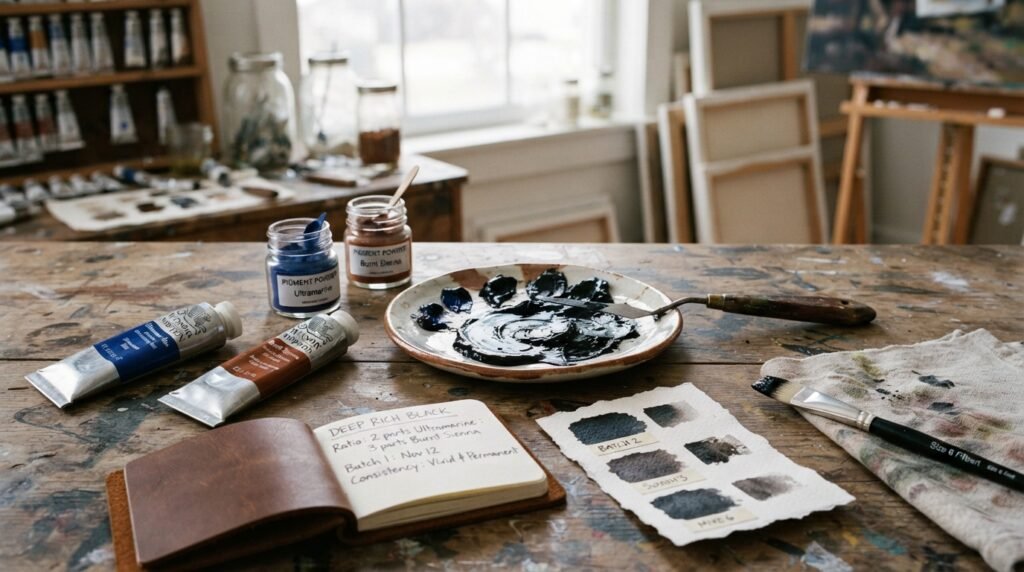
Use artist-grade pigments when possible. Student-grade paints often contain fillers that dull the final mix. A small investment in quality Ultramarine and Burnt Sienna pays off across dozens of paintings.
Test on scrap paper first. Never mix your final black directly on the canvas. Dab a small test patch on the side of your palette or a spare sheet, and let it dry before committing.
Mix in small batches. Black is notoriously hard to remix identically. If you need a lot, mix slightly more than you think you’ll need in one batch rather than trying to match a second batch later.
Keep a mixing log. Jot down the exact ratio that worked for a specific painting. Future you will be grateful when the next project calls for the same shade.
As one painting instructor puts it, “mixing your own black is like seasoning a dish from scratch instead of using a packet; it takes a little more effort, but the flavor is worth it.”
Real-Life Uses of Black
Black shows up everywhere once you start looking for it. In fashion, it remains the single most versatile color in any wardrobe, equally at home in formalwear and streetwear. In interior design, a black accent wall or black trim adds instant depth and contrast to an otherwise neutral room.
Painters reach for a hand-mixed black specifically because it holds more nuance than a flat, store-bought tube, especially in shadow work where a lifeless black can flatten an entire piece.
Shades and Variations of Black
Not every project calls for pure black. These four named variations offer useful alternatives, each with its own hex code and best use case.
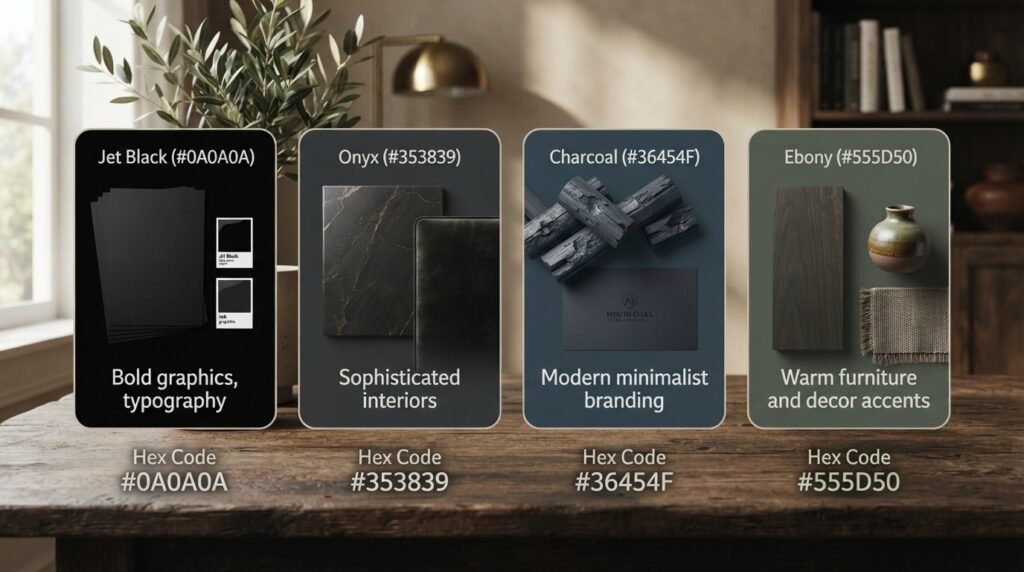
Jet Black (#0A0A0A) is the deepest, most saturated version, ideal for bold graphic design or high-contrast typography. Onyx (#353839) softens things slightly, a near-black with a subtle gray undertone that works well in sophisticated interior palettes. Charcoal (#36454F) pulls in a cooler, blue-gray cast, popular in modern minimalist branding. Ebony (#555D50) leans warmer and greener, closer to the color of the dense hardwood it’s named after, and it pairs beautifully with warm neutrals in furniture and decor.
| Variation | Hex | Best Use |
| Jet Black | #0A0A0A | Bold graphics, typography |
| Onyx | #353839 | Sophisticated interiors |
| Charcoal | #36454F | Modern minimalist branding |
| Ebony | #555D50 | Warm furniture and decor accents |
Where Black Sits on the Color Wheel
Black doesn’t technically sit on the traditional color wheel, since the wheel maps hues and black has none. Instead, painters treat it as a value, the darkest point on the lightness scale, sitting opposite white.
Because black has no hue, it doesn’t have a true complementary color the way blue and orange do. Instead, it functions as a universal neutral, pairing cleanly with every color on the wheel without clashing. That’s part of why black works as a background, an outline, or an accent in nearly any palette.
In terms of tertiary status, black is sometimes considered a “shade” rather than a color at all, the result of adding black pigment to any hue to darken it. That’s a separate concept from mixing black itself, but it’s worth knowing the distinction if you’re studying color theory further.
Conclusion
What colors make black comes down to one dependable formula: mix Ultramarine Blue and Burnt Sienna in roughly equal parts, then adjust warmer or cooler to taste. If you don’t have those two pigments handy, equal parts of red, yellow, and blue get you close enough to work with.
The real secret is testing. Mix a small batch, let it dry, compare it to what you actually need, and adjust from there. Once you’ve found your ratio, write it down. A hand-mixed black brings more depth and life to a painting than anything straight from the tube, and now you know exactly how to make it happen.
FAQs
What colors make black paint?
Ultramarine Blue and Burnt Sienna, mixed in roughly equal parts, produce the most reliable black. Equal parts of red, yellow, and blue also work, though the result leans slightly muddier.
How do you make black without black paint?
Mix any two complementary colors, like blue and orange or red and green, in roughly equal amounts. Complementary colors cancel out each other’s hue, producing a dark, neutral tone close to black.
What is the hex code for black?
Pure black’s hex code is #000000, with RGB values of 0, 0, 0. That means zero red, zero green, and zero blue light in the color.
Why does my mixed black look brown?
Too much red or yellow relative to blue usually causes a brown cast. Add small amounts of Ultramarine or Phthalo Blue gradually until the mix neutralizes.
Can you make black from primary colors alone?
Yes. Equal parts of red, yellow, and blue produce a dark, muddy near-black. It won’t be as clean as a complementary mix, but it works well when your palette is limited.
What’s the difference between mixed black and store-bought black?
Store-bought black is flat and uniform, while hand-mixed black carries subtle warm or cool undertones depending on the pigments used. Many painters prefer mixed black specifically for that added depth and richness.
How do I make my black paint darker?
Add a small amount of Payne’s Gray or a touch of commercial black as a booster, rather than relying on it as the main ingredient. Adding more of your original mixing colors in equal ratios also deepens the shade naturally.