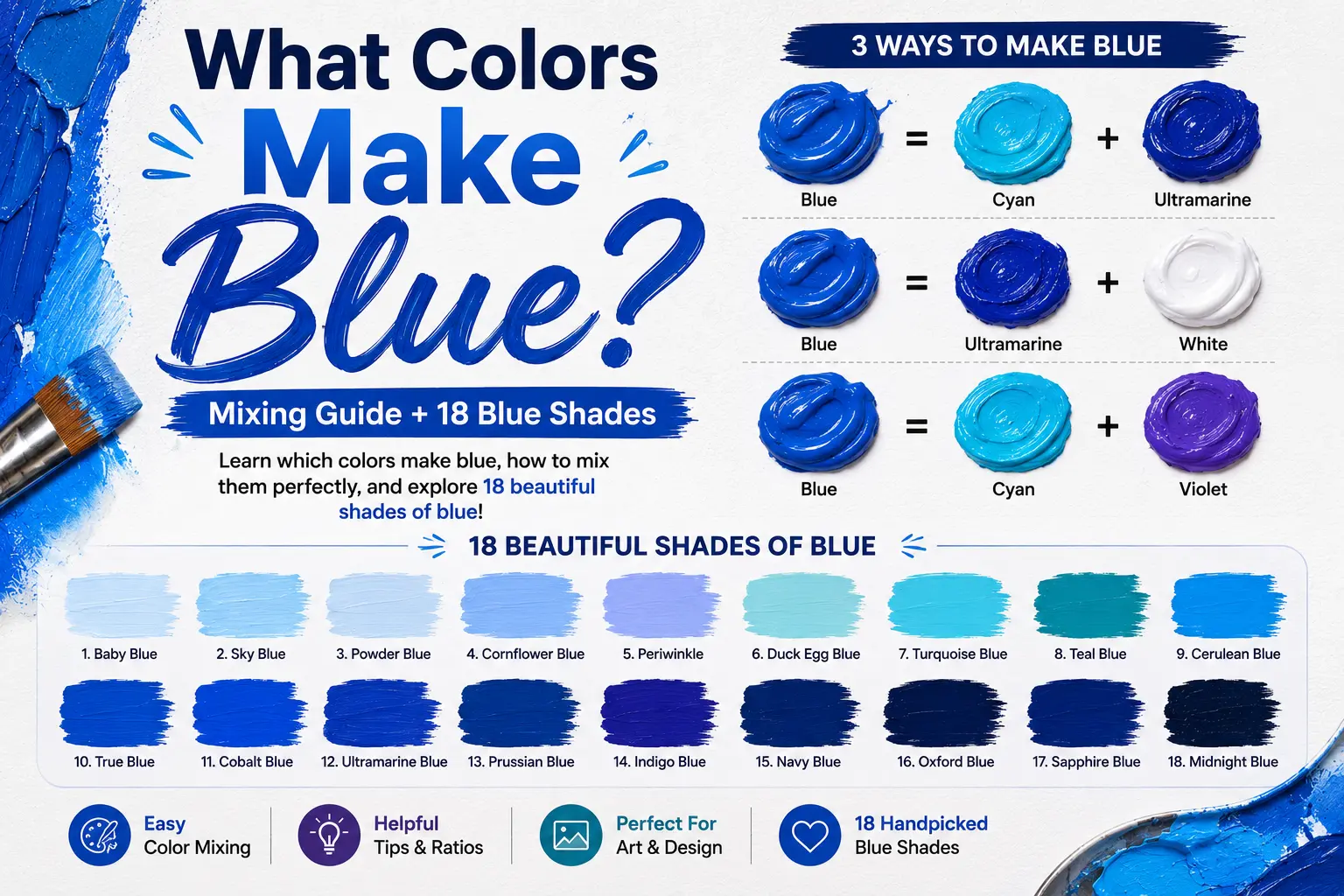
What Colors Make Blue? Mixing Guide + 18 Blue Shades
If you’ve ever wondered “what colors make blue,” you’re not alone. The straightforward answer is that you cannot mix blue from scratch using traditional paints because blue is a primary color. However, depending on the color model you use—like CMYK printing or digital screens—the way blue is formed completely changes.
Getting the perfect blue for your project relies on understanding pigment science, undertones, and shade variations. In this guide, you’ll learn how to mix over 18 custom blue shades, how modern printing creates blue without paint, and how to shift blue temperatures for painting and design.
Main Takeaway: Traditional Paint (Primary Color) = Cannot Be Mixed from Scratch; CMYK Printing (Cyan + Magenta) = Blue (depending on pigment transparency and ratios).
Why Blue Is a Primary Color in Traditional Color Theory
In traditional fine art and painting, blue sits in a special category alongside red and yellow. These three shades form the foundation of the traditional RYB (Red, Blue) color wheel.
This happens because primary pigments cannot be created by combining other physical paints. Their molecular structures reflect specific light wavelengths that you cannot recreate by blending secondary colors.
Here’s a good example. If you try mixing red and green paint together, you won’t get blue—you’ll end up with a dull brown.
Beginner Tip: Since you can’t mix a pure primary blue from scratch, always keep a tube of warm blue (like Ultramarine) and cool blue (like Phthalo or Cerulean) in your basic paint kit.
Now let’s look at how modern printing defies this traditional rule.
How Cyan and Magenta Make Blue…
While painters consider blue a primary base, modern color science views things a bit differently. In commercial printing, Cyan, Magenta, and Yellow are the true subtractive primaries.
The reason is simple. Cyan absorbs red light, while Magenta absorbs green light. When you layer Cyan and Magenta ink over each other, blue is the only light wavelength left that reflects back to your eye.
![[Cyan Ink (Absorbs Red)] + [Magenta Ink (Absorbs Green)] ===> Reflects Pure Blue](https://paintlogics.com/wp-content/uploads/2026/07/f5b84c66-d09a-4556-b9e2-ed2c78ee13f3.jpg)
Imagine looking closely at a printed magazine photo. If you use a magnifying glass on a deep blue sky in print, you’ll notice it isn’t solid blue ink—it’s actually tiny dots of Cyan and Magenta printed close together.
That’s where many beginners get confused when transitioning from printing to painting. Now compare that with how artists trick the eye on canvas.
Artist-Discovered Color Combos That Mimic Blue
While you can’t physically create pure blue pigment from scratch, artists have developed clever blending tricks to create shades that look blue to the human eye.
This optic effect relies on color context and atmospheric illusion. By pairing specific cool grays alongside warm earth tones, you can fool the eye into seeing a subtle slate blue.
[Cool Gray + Warm Brown Background] ──► Visually Shifted Slate Blue Illusion
What Does Cyan and Magenta Make?
Cyan and Magenta combine to produce a vibrant, rich blue tone. This happens because Cyan removes red light wavelengths, while Magenta removes green light. When you combine them in equal parts in printing or translucent watercolor glazes, your eyes perceive a deep cobalt-like blue.
What Does Purple and Green Make?
Mixing purple and green creates an earthy, desaturated gray-blue or slate shade. This occurs because purple contains red and blue, while green contains yellow and blue. The presence of all three primary colors creates a muted neutral that carries a strong blue undertone. Landscape painters often use this trick to paint distant mountain shadows.
Pro Tip: If your purple and green mix looks like plain mud, your green likely contained too much yellow. Switch to a cool, blue-heavy green like Phthalo Green to preserve the slate blue tone.
What Does Cyan and Violet Make?
Cyan and violet blend into a brilliant, electric deep blue. The reason this mix looks so intense is that both starting shades live right next to blue on the color wheel. By balancing Cyan’s light turquoise hue with violet’s deep red-blue quality, you get a luminous, high-energy royal blue.
How to Mix 18+ Popular Shades of Blue (Chart Included)
Once you have a base tube of blue paint, you can shift its tone to create an infinite variety of shades.
By altering ratios, adding white, or introducing complementary accents, you can shift a single tube of blue into 18 distinct variations.
![[Base Blue] + [White] ──► Pastel / Sky Shades
[Base Blue] + [Black/Burnt Umber] ──► Deep / Navy Shades
[Base Blue] + [Yellow/Cyan] ──► Teal / Turquoise Shades](https://paintlogics.com/wp-content/uploads/2026/07/f34d8ce3-1303-4e6d-813c-07b6478213f6.jpg)
Dark Shades of Blue and What Colors Make Them
Dark blue shades require dropping the value without making the pigment look muddy or dead. This is done by adding deep cool tones like Dioxazine Purple, Phthalo Green, or microscopic touches of Ivory Black. Adding Ultramarine to a touch of dark brown creates a rich midnight blue ideal for evening skies.
Light Blue Shades and What Colors Make Them
Light blues are created through tinting, which means adding white to lower the intensity. The type of white you select matters; Titanium White makes opaque pastels, while Zinc White keeps the mix semi-transparent. Blend a tiny dot of Cobalt Blue into Titanium White to get a soft, chalky baby blue.
How to Make Navy Blue
Navy blue is a deep, dark shade with a subtle cool weight. The secret to a crisp navy is mixing Ultramarine Blue with a microscopic dot of Ivory Black or Burnt Umber. The dark brown or black lowers the light value, producing a traditional nautical navy used heavily in interior design.
How to Make Teal
Teal is a rich, ocean-inspired shade sitting between green and blue. This shade occurs because it relies on a blue-green base lightened with white. Mix two parts Phthalo Blue with one part Emerald Green, then add a small touch of white to bring out the bright sea-foam undertone.
How to Make Royal Blue
Royal blue is a vivid, high-intensity shade that leans slightly toward purple. This vividness comes from pairing a pure, vibrant blue with a tiny touch of warm magenta or violet. Combine Cobalt Blue with a tiny drop of Magenta to give the color a rich, striking punch.
How to Make Sky Blue
Sky blue is a bright, clear tint that feels open and airy. This light quality is created by combining a cool blue with white and a microscopic hint of yellow to mimic atmospheric sunlight. Blend Cerulean Blue with Titanium White and a pinprick of Lemon Yellow for an authentic midday sky.
How to Make Indigo (or Deep Blue-Violet)
Indigo is a dark, moody hue that bridges blue and violet. This happens because red-violet tones dominate the blue base. Mix three parts Ultramarine Blue with one part Dioxazine Purple to achieve a deep indigo tone frequently seen in natural denim dyes.
How to Make Periwinkle Blue
Periwinkle is a soft, pastel shade with a distinct blue-purple identity. The reason for its sweet tone is a high dose of white softening a balanced blue-violet mix. Blend equal parts pastel pink and sky blue, then add extra white paint until it reaches a delicate flower petal consistency.
| Blue Shade | Base Color | Secondary Color | White / Adjuster | Resulting Hue |
| Navy Blue | Ultramarine Blue | Burnt Umber | None | Deep Midnight Navy |
| Teal | Phthalo Blue | Emerald Green | Touch of White | Ocean Teal |
| Royal Blue | Cobalt Blue | Magenta | None | Vivid Royal Blue |
| Sky Blue | Cerulean Blue | Lemon Yellow (Tiny) | Titanium White | Clear Sky Blue |
| Indigo | Ultramarine Blue | Dioxazine Purple | None | Deep Blue-Violet |
| Periwinkle | Sky Blue | Pastel Pink | Extra White | Soft Blue-Lavender |
| Baby Blue | Cobalt Blue | None | High White Ratio | Soft Pastel Blue |
| Turquoise | Cyan / Primary Blue | Bright Yellow | Touch of White | Tropical Turquoise |
| Slate Blue | Ultramarine Blue | Medium Gray | None | Muted Storm Gray-Blue |
| Steel Blue | Cobalt Blue | Raw Umber | White | Metallic Industrial Blue |
| Denim Blue | Prussian Blue | Warm White | Touch of Black | Classic Workwear Blue |
| Cornflower | Cobalt Blue | Soft Violet | Titanium White | Bright Floral Blue |
| Ice Blue | Cerulean Blue | Phthalo Green (Tiny) | High White Ratio | Very Pale Frost Blue |
| Sapphire | Ultramarine Blue | Phthalo Blue | None | Deep Gemstone Blue |
| Prussian Blue | Base Blue | Black | Phthalo Green | Deep Vintage Ink |
| Electric Blue | Cyan | Magenta | White | High-Vibrancy Digital Look |
| Powder Blue | Primary Blue | Pale Gray | High White Ratio | Chalky Soft Blue |
| Midnight Blue | Phthalo Blue | Dioxazine Purple | Micro Black | Near-Black Deep Evening |
How to Make Navy Blue, Teal, Royal Blue & More
Beyond two-color combinations, understanding how blue interacts with every other main color group gives you total control over your palette.
The reason is that every color you add to blue either pulls its temperature, desaturates its chroma, or alters its lightness.
![[Blue] + [Orange (Complement)] ──► Muted Slate / Neutral Gray-Blue
[Blue] + [Red] ──► Purple / Violet Shift
[Blue] + [Yellow] ──► Green Shift](https://paintlogics.com/wp-content/uploads/2026/07/86aa444f-df7b-42bb-b3b2-1c47d332a3b3.jpg)
What Does Red and Blue Make?
Red and blue mix together to make purple or violet. When red light waves combine with blue wavelengths, they create a secondary hue. Using a warm red like Cadmium Red creates a dark, brownish purple, while using a cool magenta yields a bright, clean violet.
What Does Blue and Orange Make?
Blue and orange are direct complements on the color wheel, meaning they cancel each other out. When mixed, they create a muted, earthy gray or brown. Adding a tiny touch of orange to blue is the best way to tone down a blue that looks overly bright or synthetic.
What Does Blue and Pink Make?
Blue and pink blend into soft purples like lavender, lilac, and periwinkle. This happens because pink is red diluted with white. The red inside the pink turns the blue into violet, while the built-in white lightens the final value into a delicate pastel.
What Does Blue and Purple Make?
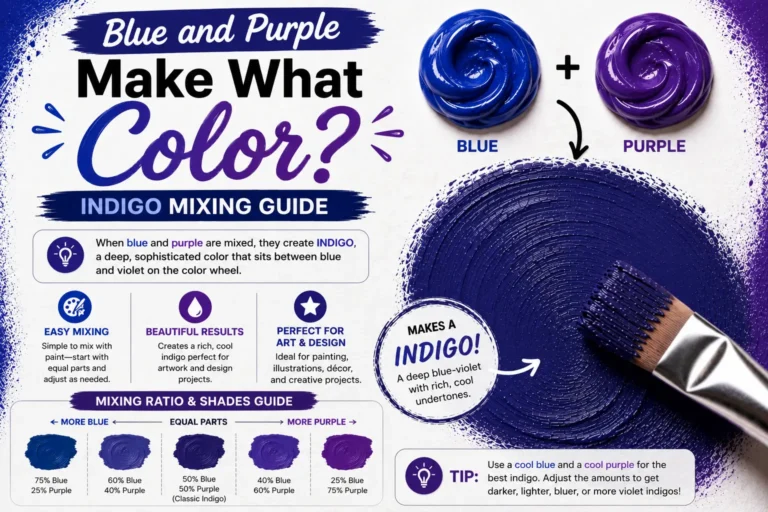
Blue and purple combine into blue-violet or indigo. Because purple already contains blue, adding more blue pushes the color toward the cooler side of the spectrum, creating a deep, night-sky aesthetic.
What Does Blue and Brown Make?
Blue and brown produce a series of rich, dark neutrals and storm grays. Blending Ultramarine Blue with Burnt Sienna creates a versatile dark tone that painters use as a rich alternative to flat black paint.
What Does Blue and White Make
Blue and white make light blue, tinting the base color into soft pastel shades like sky, baby, and powder blue. White raises the overall brightness while lowering color intensity.
Does Blue and Green Make Teal?
Yes, blue and green make teal, turquoise, and seafoam. Increasing the blue ratio gives you a cool deep teal, while increasing the green ratio pushes it toward a tropical turquoise.
Understanding Blue in Digital Models: RGB vs CMYK
The way blue functions shifts completely when you switch from physical mediums to digital designs.
This difference exists because computer screens project light, whereas physical paints and print inks absorb light.
![SCREENS (Additive RGB) PRINT (Subtractive CMYK)
[Red] + [Green] + [Blue] [Cyan Ink] + [Magenta Ink]
│ │
▼ ▼
Creates Light & White Creates Absorptive Blue Pigment](https://paintlogics.com/wp-content/uploads/2026/07/8f90463b-ce01-4eb5-91ac-9b1433cedbe6.jpg)
Why Is It Hard to Mix a True Blue in Painting?
It is impossible to mix a true primary blue in painting because physical pigments are subtractive. They absorb light waves rather than generating them. Once a pigment tube lacks blue-reflecting molecules, no amount of mixing other paints can force it to reflect pure blue light.
What Colors Make Blue in Digital Screens?
On digital screens using the RGB model, Blue is a primary color of light. You don’t mix other colors to create blue digitally; instead, you set the Blue channel (B) to 100% (or 255) while keeping Red (R) and Green (G) at 0.
Can You Make Blue Without Blue Paint?
If you are stranded at an easel without a tube of blue paint, you cannot create a pure, saturated primary blue out of thin air.
However, you can create optical blue substitutes using gray and cool earth tones. This effect works because human eyes perceive color relative to surrounding shades.
Here’s a good example. If you place a cool mixture of Ivory Black and Titanium White next to a warm, vivid orange background, the gray swatch will optically shift and appear distinctly blue to the viewer.
Blue Myths Debunked: Purple + Green ≠ Blue
A common myth floating around beginner art forums is that mixing purple and green paint will create a clean blue.
The reason this myth fails is simple arithmetic on the color wheel. Purple contains red and blue, while green contains yellow and blue. Mixing them together means you are combining red, yellow, and blue simultaneously.
[Purple (Red + Blue)] + [Green (Yellow + Blue)] ===> Contains All 3 Primaries ===> Muddy Brown
Instead of a clean blue, you get a muddy gray-brown because the presence of yellow cancels out the purity of the blue pigment.
What Colors Make Blue Eyes Pop?
If you are styling an outfit or applying makeup, choosing colors that sit opposite blue on the color wheel will make blue eyes look striking.
This contrast works because complementary colors boost each other’s visual intensity when placed side by side.
[Warm Copper / Bronze] <— Complementary Contrast —> [Blue Eyes]
- Warm Earth Tones: Copper, bronze, terracotta, and warm gold make blue eyes pop dramatically.
- Deep Neutrals: Charcoal gray, deep navy, and rich chocolate brown provide high contrast.
- Complementary Accents: Peach, coral, and warm orange-browns draw out blue eye tones instantly.
How to Make Blue Food Coloring Naturally
Creating natural blue dye for baking or cooking can be tricky because blue pigments are extremely rare in culinary plants.
The secret to natural blue dye lies in spirulina or red cabbage extract modified with baking soda.
[Red Cabbage Juice (Purple/Acidic)] + [Baking Soda (Alkaline)] ===> True Natural Blue Dye
Boil chopped red cabbage in water until you get a deep purple liquid. Slowly stir in a tiny pinch of baking soda to alter the pH level. As the solution becomes alkaline, the purple liquid magically transforms into a vivid, food-safe blue dye.
CONCLUSION: What Colors Make Blue?
When asking “what colors make blue,” remember that in traditional painting, blue is a primary color that cannot be mixed from other paints. However, in CMYK printing, Cyan and Magenta combine to produce blue, while in digital screens, blue exists as a pure light primary.
Understanding how to manipulate your base blues with white, brown, purple, and green allows you to craft over 18 stunning custom shades for any artistic or design project. Keep experimenting on your palette, pay attention to pigment undertones, and enjoy crafting unique blue shades for your work.
Explore More Color Mixing Guides:
- What Colors Make Green? Easy Color Mixing Guide for Every Shade
- Pink and Green Make What Color? Complete Mixing Guide
- What Color Does Pink and Blue Make? Discover 9 Amazing Shades of Purple
FAQS
What color does blue and pink make?
Blue and pink make soft shades of purple, such as lavender, lilac, and periwinkle. The red inside the pink turns the blue toward violet, while the white in the pink lightens it into a pastel tone.
What colors make blue food coloring?
Natural blue food coloring is made using spirulina powder or by mixing red cabbage juice with a small pinch of baking soda to shift its pH level from purple to blue.
What two colors make navy blue?
In paint mixing, you create navy blue by combining a rich blue (like Ultramarine) with a tiny amount of Ivory Black or Burnt Umber.
What color makes royal blue?
Royal blue is made by adding a tiny touch of Magenta or warm violet to a vibrant Cobalt or Ultramarine blue base to give it a rich, purple-leaning intensity.
What colors make baby blue?
Baby blue is made by mixing a large amount of Titanium White paint with a tiny dot of Cobalt Blue or Cerulean Blue.
What colors make light blue?
Light blue is created by adding white paint to any base blue. Adding a tiny hint of Lemon Yellow creates a sky blue, while adding a hint of gray creates a muted slate blue.
Can you mix food colors to make blue naturally?
You cannot mix standard artificial red, yellow, or green food dyes to get blue. You must use a dedicated blue source like phycocyanin (spirulina extract) or pH-adjusted red cabbage juice.
What colors make blue crayons?
Blue crayons are manufactured using synthetic blue pigments (like Phthalo Blue or Prussian Blue) blended into melted paraffin wax and clay fillers.
What colors make blue in digital screens?
On digital RGB screens, blue is a primary light source. It isn’t made by mixing other colors; rather, the screen turns on pure blue light pixels at maximum intensity.
What two natural dyes make blue?
Historically, natural blue dyes were extracted from the Indigofera plant (indigo) and Isatis tinctoria (woad).
Can I mix blue from three colors?
No. Mixing three traditional primary paints (red, yellow, and blue) or secondary colors will produce brown, gray, or black, never a pure blue.
Can You Make Blue from Crayons?
You cannot melt red, yellow, or green crayons together to create a pure blue crayon. You must start with a crayon that already contains blue pigment.