Orange and Purple Make What Color? Paint Mixing Guide
If you’ve ever wondered “orange and purple make what color,” you’re not alone. It’s one of those classic studio questions that pops up when you’re trying to mix a realistic shadow for a piece of fruit, paint a moody twilight landscape, or design a cozy, earthy brand identity.
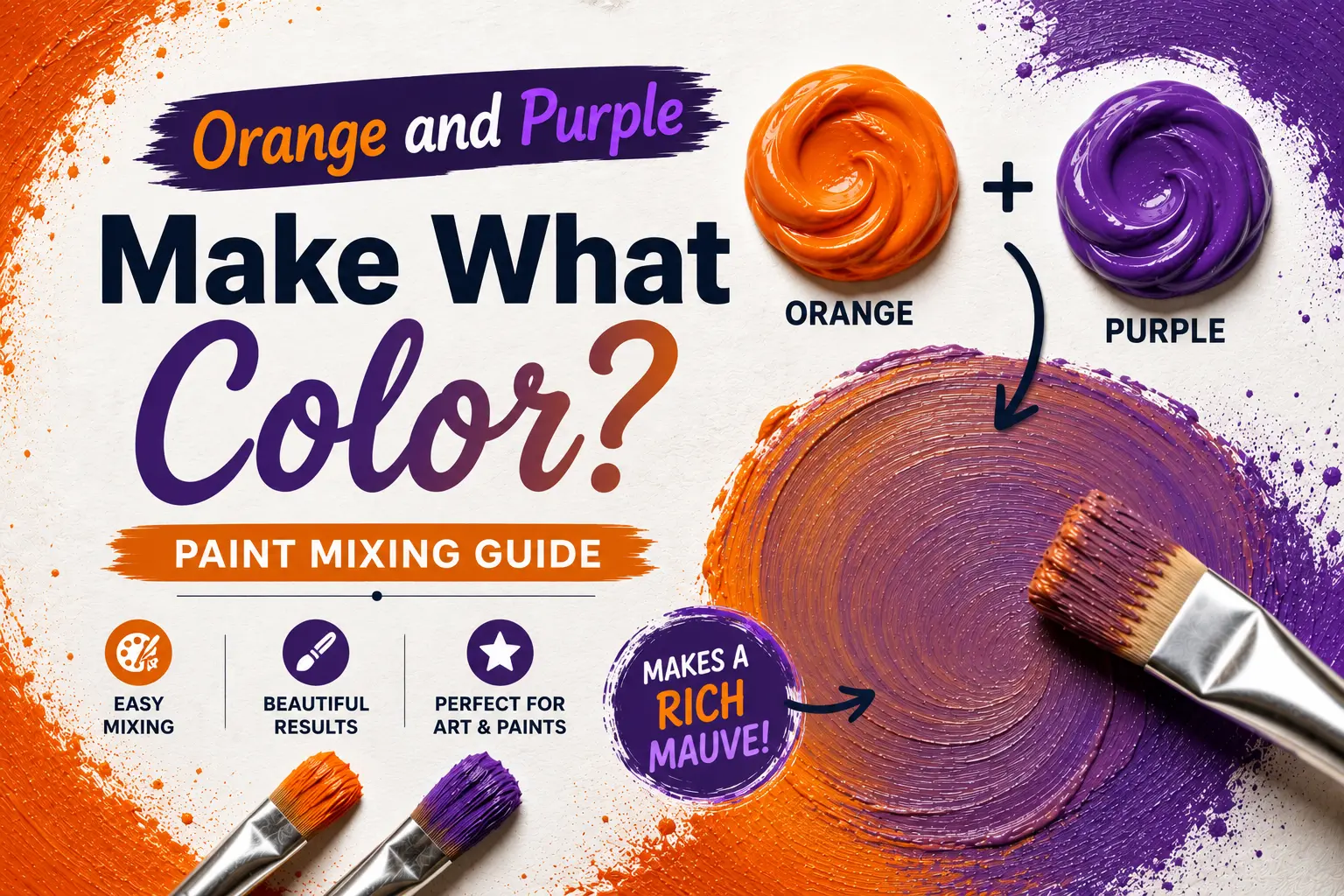
The direct answer is simple: when you mix orange and purple together in physical medium like paint, they combine to make a deep, rich brown or a reddish-brown shade known as russet.
However, the final result isn’t always identical every single time you sweep them together. The exact hue you produce depends heavily on the specific pigment undertones of your paints, the medium you are using, and the mixing ratios on your palette. Understanding how these two complex secondary colors behave when crossed gives you ultimate control over a vast spectrum of sophisticated earth tones. In this guide, you’ll learn the exact color science behind this blend, how different paint pigments behave when crossed, and how to utilize these radiant tones across various creative mediums.
Main Takeaway:
Secondary Orange + Secondary Purple = Brown / Russet (varying in depth and warmth depending on your starting pigment ratios and undertones).
Quick Answer: What Color Do Orange and Purple Make?
When you combine orange and purple on your mixing tray, they merge to form a beautiful, complex tertiary or quaternary brown. Because both starting colors are already blends of primary colors, they don’t produce a clean, bright primary or secondary shade; instead, they create a beautifully muted earth tone.
Why does this happen? The reason is simple: orange and purple are secondary colors that sit on opposite sides of the color wheel’s warm-to-cool dividing line. When they meet, they instantly temper each other’s high vibrancy. The result is a highly sophisticated, organic color that can lean toward a fiery, warm mahogany or a cool, plum-toned chocolate.
Imagine you’re painting a forest scene in late autumn. If you take a pool of standard violet and slowly stir in a dollop of cadmium orange, the bright purple loses its cool, electric edge. It transitions away from a bright berry color and turns into a deep, mossy russet that looks incredibly natural and atmospheric.
Why Do Orange and Purple Make Brown?
To get a grip on this mixture, you have to look at how light wavelengths interact when these pigments collide. Both colors contain competing primary pigments that fight for dominance.
Primary Color Breakdown
When we break these colors down to their basic elements, we see that orange is made of red and yellow, while purple is made of red and blue. When you mix them, you are actually throwing all three primary colors—red, yellow, and blue—into the same pool. Red acts as the major bridge between them since it is present in both parents.
The Color Science Behind the Mix
This happens because mixing all three primary colors triggers a subtractive color process. Each pigment absorbs, or subtracts, different light waves from the spectrum. Since red, yellow, and blue together absorb almost all of the bright, clean light wavelengths, the mixture loses its saturation. Because red is the dominant shared color in both parents, the resulting neutral defaults to a warm, red-toned brown rather than a lifeless gray.
What Happens When You Mix Different Shades of Orange and Purple?
The specific tubes of paint you pull from your studio box dictate the ultimate outcome of your mixture. Subtle pigment shifts change the energy of your mix completely.
Examples of Mixing Orange and Purple
If you mix a warm, yellow-leaning Tangerine Orange with a deep Royal Purple, you’ll get a classic, neutral chocolate brown. On the flip side, mixing a fiery red-orange with a reddish plum purple yields a rich, warm russet that glows with fiery undertones.
Table of Mixing Results
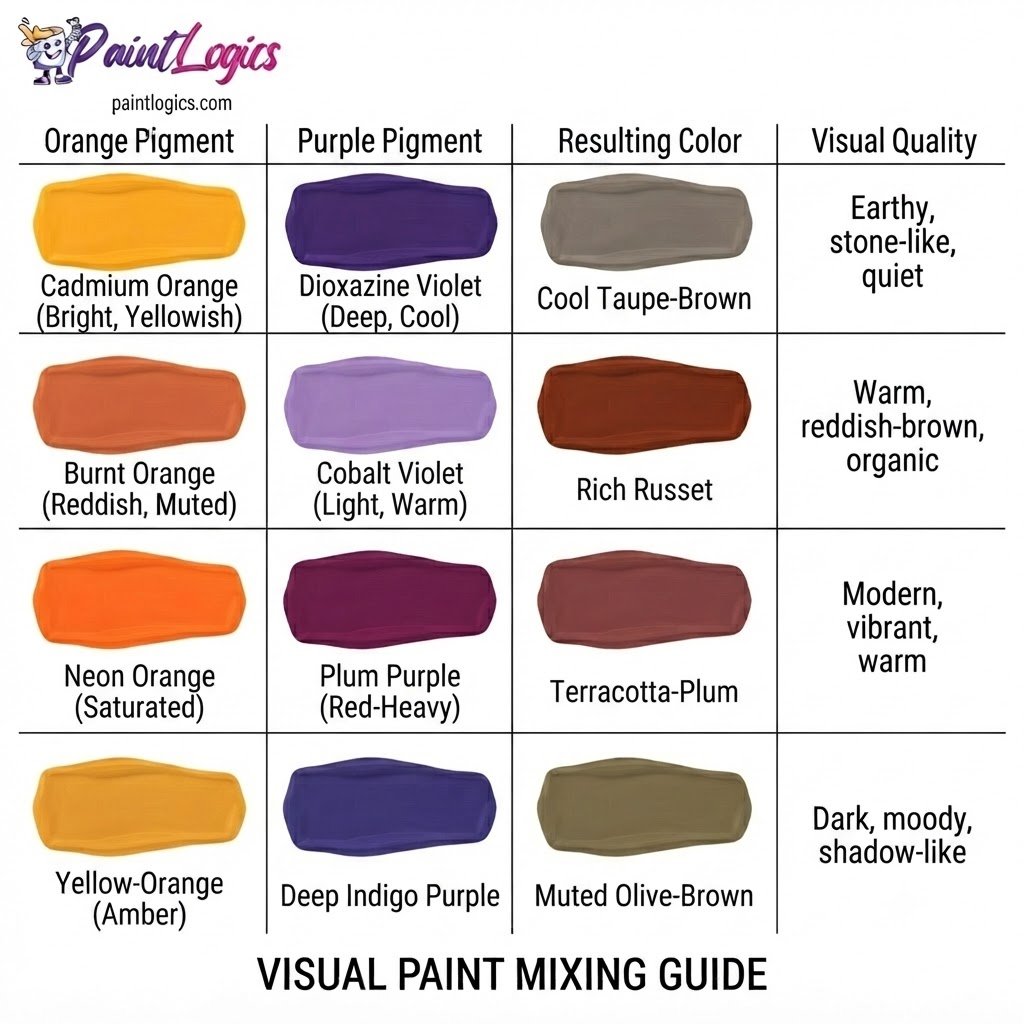
Now let’s look at how different starting variations interact on the mixing tray:
| Orange Pigment | Purple Pigment | Resulting Color | Visual Quality |
| Cadmium Orange (Bright, Yellowish) | Dioxazine Violet (Deep, Cool) | Cool Taupe-Brown | Earthy, stone-like, quiet |
| Burnt Orange (Reddish, Muted) | Cobalt Violet (Light, Warm) | Rich Russet | Warm, reddish-brown, organic |
| Neon Orange (Saturated) | Plum Purple (Red-Heavy) | Terracotta-Plum | Modern, vibrant, warm |
| Yellow-Orange (Amber) | Deep Indigo Purple | Muted Olive-Brown | Dark, moody, shadow-like |
Common Mistake: Mixing a highly transparent, yellow-heavy orange with a cold, blue-heavy purple. The blue in the purple and the yellow in the orange will try to make green, resulting in a muddy olive-brown rather than a clean, rich mahogany.
Why Different Orange-Purple Mixes Create Different Browns
The character of your final neutral shifts dramatically depending on the dominant base pigments inside your tubes.
Here’s why: some purples are blue-dominant (like Ultramarine Violet), while others are red-dominant (like Quinacridone Violet). Similarly, an orange can lean heavily toward yellow (like Chrome Orange) or red (like Cadmium Red Light). If your starting colors are red-heavy, your brown will lean toward a fiery, warm russet or mahogany. If they are blue-heavy, your mixture will slide toward a cool, stony taupe.
Quick Guide: Mixing Orange and Purple in Different Mediums
The physical characteristics of your specific medium determine how you should approach this mix on your palette.
- Acrylic Paint: Acrylics dry slightly darker and flatter than when they are wet. When mixing your orange and purple acrylics, make the wet mixture a fraction of a shade lighter than your target color to compensate.
- Oil Paint: Oils are highly saturated and slow-drying, allowing you to blend your orange and purple directly on the canvas to create beautiful, soft gradient transitions.
- Watercolor: Watercolors are transparent, so the white paper beneath reflects light through the pigment. Mixing orange and purple in watercolor creates beautiful, luminous glaze layers that are perfect for rendering natural shadows.
Orange and Purple in Paint: RYB Color Model Results
In the traditional RYB (Red, Yellow, Blue) color model used by painters, orange and green, and purple are all secondary colors.
RYB Color Model in Painting
When you combine two secondary colors like orange and purple, you are creating a quaternary color. Because you are mixing three primary pigments (red, yellow, and blue) with a heavy emphasis on red, the RYB model naturally drives the physical paint mixture into a rich, earth-toned brown.
Challenges in Mixing Orange and Purple in Paint
That’s where many beginners get confused. Because purple and orange have such different tinting strengths, the dark purple can easily swallow up your bright orange. It takes a lot of orange to warm up a dark violet, so you must always mix your paint slowly.
Pro Tip: Always start with your lighter orange paint as your base pile, then introduce your dark purple in tiny, toothpick-sized increments until you reach your desired brown.
What Happens When You Mix Orange and Purple in Lights?
When you move off the canvas and step behind a digital screen, the laws of physics turn upside down.
RGB Color Model in Lighting
Digital displays operate on the additive RGB (Red, Green, Blue) model, where colors are created by projecting colored light beams directly into your eyes. In this system, orange light is a mix of red and green light, while purple light is a mix of red and blue light.
How Light Mixing Differs from Paint Mixing
When you mix orange and purple light, you are adding green, blue, and a double portion of red light waves together. Instead of getting a dark, subtractive brown, you get a much brighter, lighter, and highly luminous warm peach or light magenta-pink.
What Color Do Orange and Purple Make in Digital Art?
For digital illustrators, translating the feel of traditional paint mixing onto a computer screen requires a bit of software know-how.
Additive vs. Subtractive Mixing in Digital Art
If you use a standard digital brush with normal opacity settings, laying down purple over orange simply covers the orange pixels. To mimic the beautiful, muddy brown or russet that physical painters get, you must set your digital brush layer blend mode to “Multiply” or “Color Burn” to simulate subtractive pigment behavior.
Adjusting the Orange-Purple Mix for Desired Effects
Once you have your base brown mixture on your palette, you can easily steer its mood and value.
Making Tints and Shades of Orange-Purple Brown
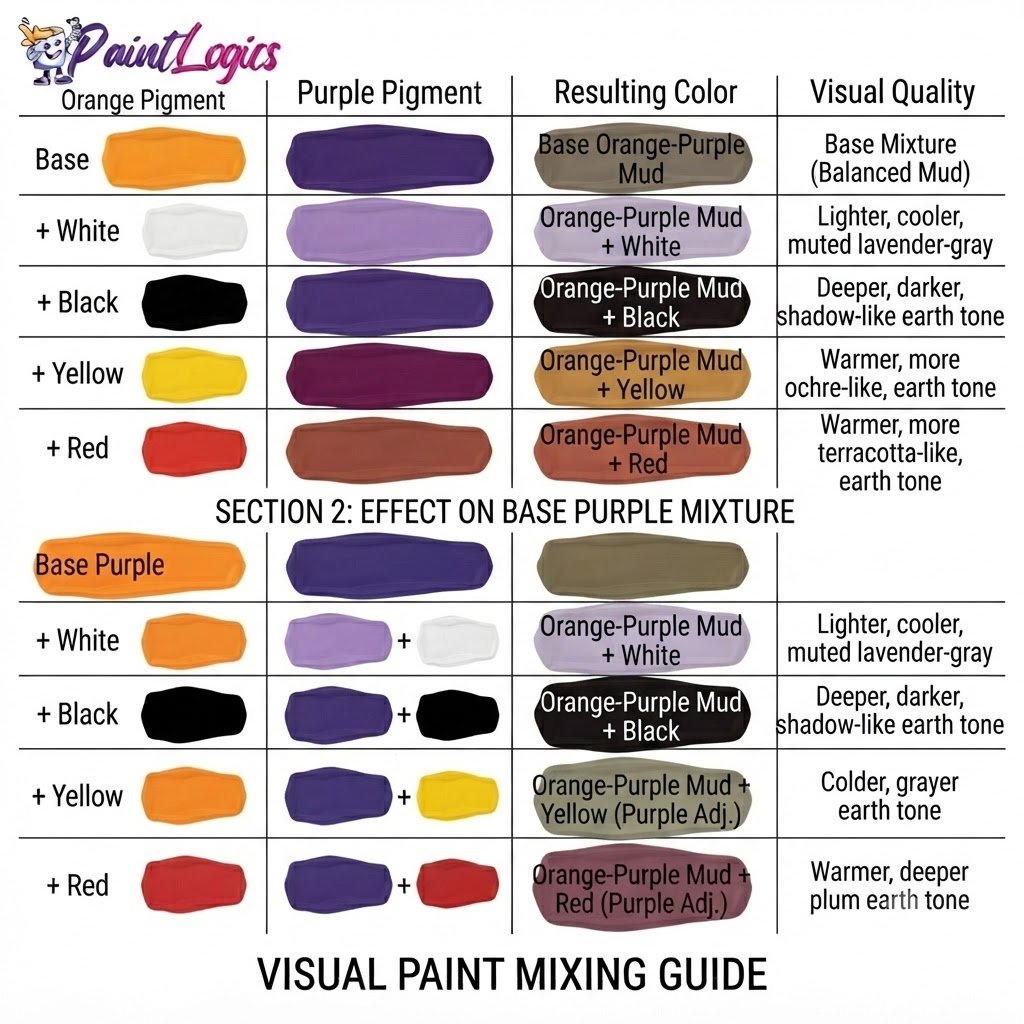
- To Lighten (Make a Tint): Add a splash of white paint. This transforms your deep russet into a beautiful, soft taupe, dusty rose, or warm “greige” neutral.
- To Darken (Make a Shade): Add a pinpoint of black paint or a touch of burnt umber. This pulls your mixture down into a deep, mysterious espresso or dark chocolate tone.
- To Warm Up: Fold in a drop of yellow or red paint to pull the mix back toward a bright, fiery amber-brown.
What Happens When Orange Are Mixed with Other Colors?
Once you have your base orange-purple mixture sitting on your palette, dropping in a third color component allows you to cross over into completely different color families.
Here’s how a third variable shifts the entire balance of your neutral mix:
Orange, Purple, and Red: A Darker Brown or Russet
Adding more red drives the mixture straight back to its warm roots, transforming your soft brown into a fiery, passionate russet or rich brick red.
Orange, Purple, and Yellow: A Warmer, Earthier Brown
The yellow supercharges the warmth of the entire system, pulling your dark brown into a bright, golden ochre or warm chestnut.
Orange, Purple, and Blue: A Cooler, Muted Brown
The blue cools down the warm red foundation, transforming your rustic brown into a deep, smoky slate gray or dark charcoal shadow.
Orange and Purple in Design: How to Use the Resulting Color
This high-contrast pairing is highly prized across various creative fields because it creates a sense of luxury, creativity, and visual drama.

Graphic Design: Bold Contrasts and Attention-Grabbing Designs
In digital design, pairing orange and purple next to each other creates an electric, modern energy. Think of sports team branding or tech logos; the high contrast grabs eyes instantly and projects a playful, confident attitude.
Interior Design: Creating Dynamic Spaces with Orange and Purple
Interior designers use these colors to bring a creative, luxurious energy to personal spaces. Imagine a room with a deep plum purple accent wall complemented by burnt orange velvet chairs and warm brass fixtures—it feels incredibly cozy, warm, and high-end.
Fashion Design: Bold and Unique Outfits
In fashion, pairing these two tones is a favorite trend for confident color-blocking. Styling a bright orange trench coat over a deep purple silk dress creates a sophisticated, runway-ready look that feels highly intentional and stylish.
Conclusion
To wrap things up, orange and purple make brown or russet. Because these two secondary colors sit on opposite sides of the color wheel and contain all three primary pigments, mixing them triggers a natural neutralization process that strips away their bright intensity, leaving behind a highly sophisticated, organic neutral.
The entire secret to mastering this beautiful blend lies in starting with your lighter orange paint as your main base, introducing your dark purple pigment in small, controlled steps, and keeping your medium in mind. Whether you are illustrating an autumn sunset, styling a confident wardrobe, or picking a relaxing paint scheme for your home, utilizing this rich neutral family adds instant warmth, depth, and natural balance to your creative projects.
You Might Also Like:
- Red and Orange Make What Color? Complete Mixing Guide
- Purple and Black Make What Color? Dark Purple Mixing Guide
FAQs
Q: What color does orange and purple make when mixed?
They combine to form a beautiful, natural range of warm neutrals, yielding a rich brown, warm russet, or dusty mahogany depending on your mixing ratios.
Q: Can mixing orange and purple make other colors?
Yes, depending on your ratios and adjusters, you can guide the mix to create soft taupe, deep espresso, or warm terracotta.
Q: What type of green do orange and purple make?
They do not make green. Because they both contain red, they will always lean toward the brown, reddish-brown, or gray spectrum rather than green.
Q: Can I make blue from yellow and other colors?
No. Blue is a primary color, meaning it cannot be created by mixing other colors together. You must buy pure blue pigment straight from the store.
Q: How do different blues affect the green made by mixing with yellow?
A warm blue like Ultramarine contains red undertones, which will slightly muddy your green mix into an olive. A cool blue like Phthalo contains green undertones, which will yield an incredibly bright, vivid kelly green.
Q: What happens when you add white to orange and purple?
Adding white paint lifts the overall value and diffuses the dense pigments, softening a dark russet brown into a beautiful, dusty rose or warm sandstone pastel.
Q: What happens when you add black to orange and purple?
A microscopic pinch of black paint swallows up the light reflection, turning your warm brown into a deep, rich espresso or near-black shadow.
Q: Can orange and purple create a brownish color?
Yes, absolutely! Mixing them is one of the most reliable ways to create beautiful, realistic wood tones and natural brown shadows.
Q: What are the artistic uses of orange and purple together?
They are highly prized for painting realistic shadows on orange objects, rendering autumn foliage, illustrating dramatic sunset horizons, and creating high-contrast abstract art.
Q: How does the CMYK model affect orange and purple mixing?
Because printing ink is subtractive, mixing orange and purple inks on paper will absorb light, resulting in a deep, matte brown or dark plum-russet shade.
Q: Why is orange and purple an important color combination?
It is an analogous-complementary crossover that provides maximum visual contrast and energy when placed side-by-side, while blending to create beautiful, natural neutrals.
Q: Can I make green with just yellow and blue pigments?
Yes. Green is a secondary color created by mixing primary blue and yellow together.