24 Colors That Start With C (Names, Hex, RGB, CMYK)
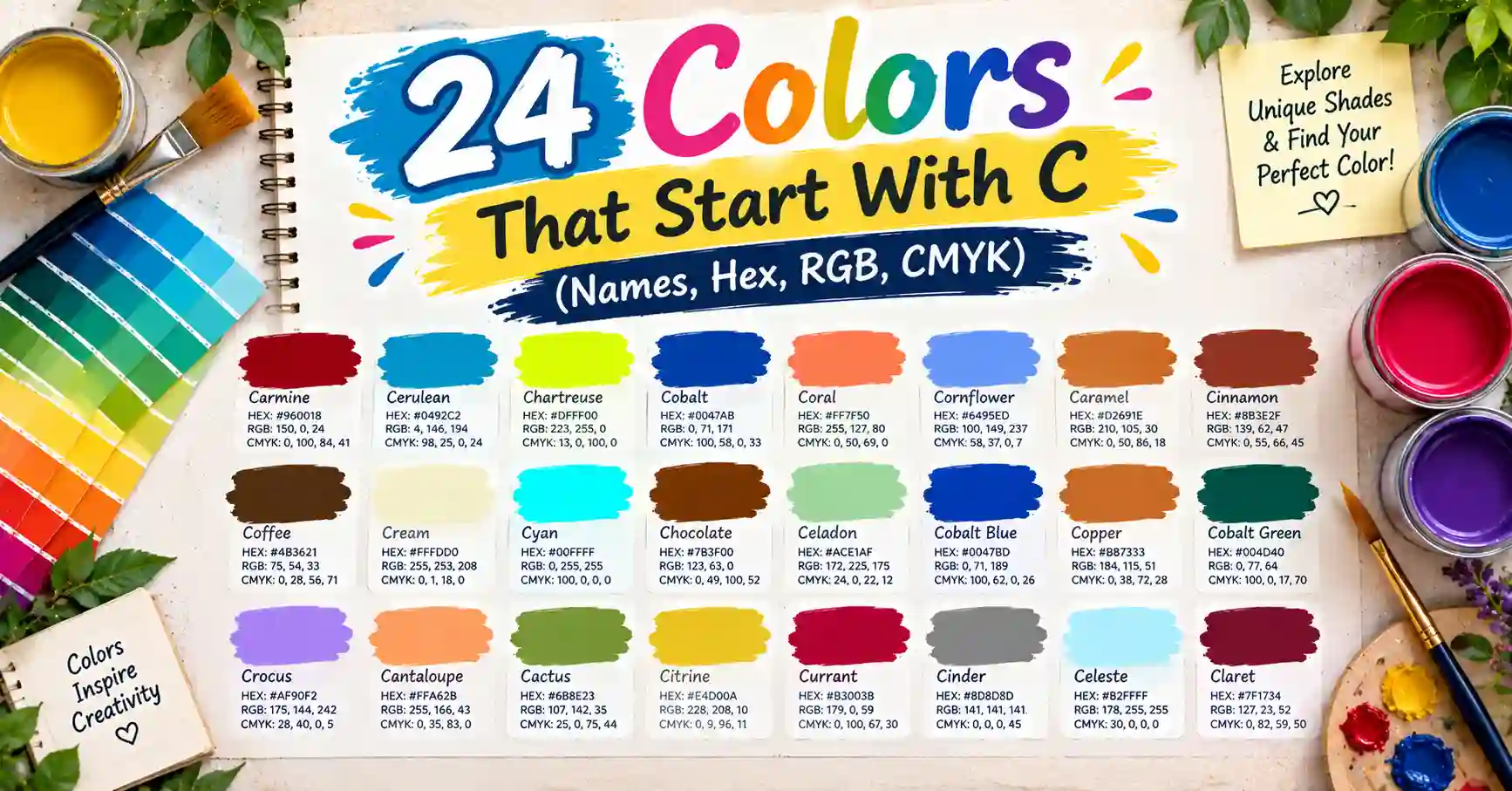
If you’ve ever described a color as “cobalt,” “coral,” or “chocolate” without thinking twice, you’ve already used colors that start with C without realizing how many real, standardized shades sit under that one letter. This guide lists 24 genuine color names starting with C, each with a verified Hex code, RGB value, and a calculated CMYK conversion for print work. Every entry below comes from either the official CSS/X11 color specification or a well-documented traditional source, cross-checked against at least two references.
Quick Jump Guide
Before diving into the full list, here’s what families of colors that start with C you’ll find in this guide: warm reds and pinks, earthy oranges and browns, a couple of standout yellows, two distinct greens, a wide spread of blues, and a trio of soft neutrals. If you already know roughly what shade you’re after, the family table further down will get you there faster than scrolling the full alphabetical list.
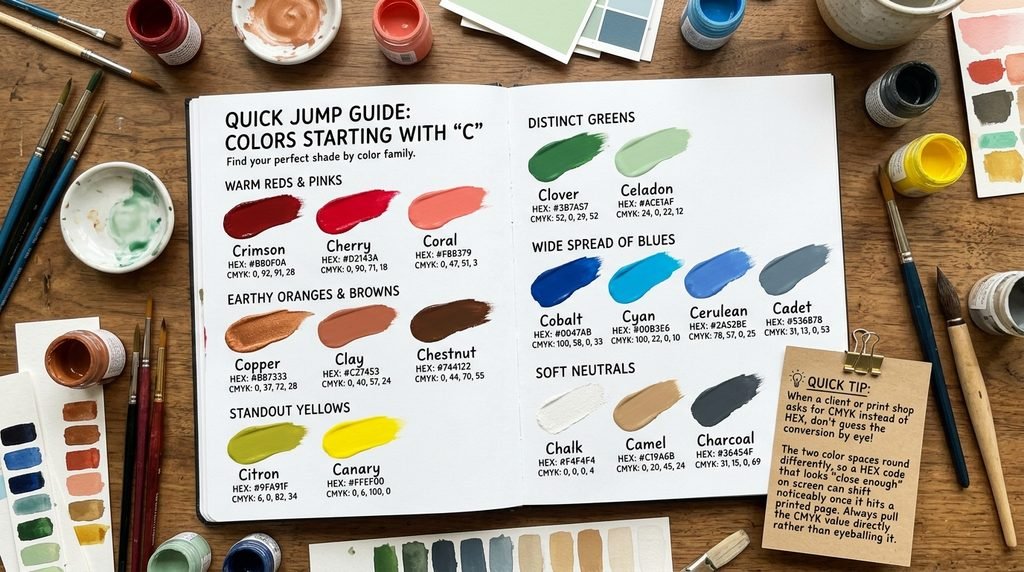
Quick Tip: When a client or a print shop asks for CMYK instead of Hex, don’t guess the conversion by eye. The two color spaces round differently, so a Hex code that looks “close enough” on screen can shift noticeably once it hits a printed page. Always pull the CMYK value directly rather than eyeballing it.
The Full List of Colors That Start With C
Cadet Blue
A muted, grayish blue with just enough green mixed in to keep it from reading as cold. It’s the understated cousin of Cornflower Blue, better suited to backgrounds than headlines.
Hex: #5F9EA0 | RGB: 95, 158, 160 | CMYK: 41, 1, 0, 37
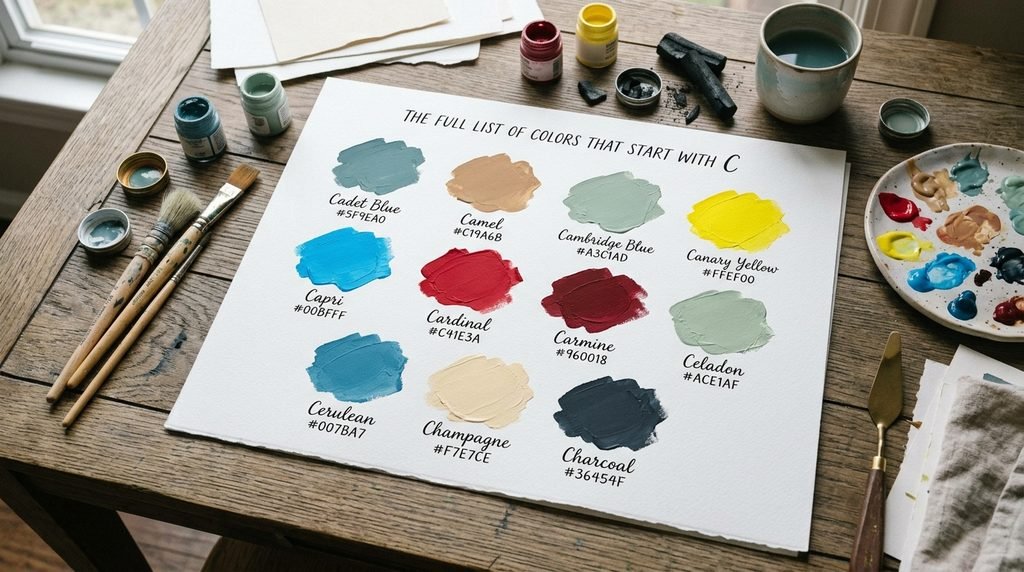
Camel
Named after the animal’s coat, this is a soft, yellow-leaning brown that sits between tan and caramel. It reads as warm rather than drab, which is why it shows up so often in outerwear.
Hex: #C19A6B | RGB: 193, 154, 107 | CMYK: 0, 20, 45, 24
Cambridge Blue
A pale, dusty blue-green borrowed from the university’s traditional rowing color. It’s softer and more muted than Cadet Blue, closer to sage than to true blue.
Hex: #A3C1AD | RGB: 163, 193, 173 | CMYK: 16, 0, 10, 24
Canary Yellow
A bright, slightly cool yellow named for the bird’s plumage rather than the color wheel’s primary yellow. It carries more lemon than gold, which makes it crisper than Citrine.
Hex: #FFEF00 | RGB: 255, 239, 0 | CMYK: 0, 6, 100, 0
Capri
A vivid, saturated sky blue named after the Italian island, known for the brilliant blue water along its coastline. It’s bolder and more electric than Cerulean, with almost no green in it at all.
Hex: #00BFFF | RGB: 0, 191, 255 | CMYK: 100, 25, 0, 0
Cardinal
An intense, slightly blue-leaning red drawn from either the bird or the robes worn by Catholic cardinals. Compared to Crimson, it carries a touch more weight and less brightness.
Hex: #C41E3A | RGB: 196, 30, 58 | CMYK: 0, 85, 70, 23
Carmine
A deep, almost wine-dark red historically derived from crushed cochineal insects, once one of the most prized dyes in the world. It runs darker and more serious than Cardinal, closer to dried blood than fire engine red.
Hex: #960018 | RGB: 150, 0, 24 | CMYK: 0, 100, 84, 41
Celadon
A soft, grayish green with a faint blue cast, named after the pale glaze used on centuries-old Chinese and Korean pottery. It reads as quiet and washed-out next to Chartreuse’s full saturation.
Hex: #ACE1AF | RGB: 172, 225, 175 | CMYK: 24, 0, 22, 12
Cerulean
A calm, medium blue with a slight greenish cast, closer to open seawater than to a bright, cloudless sky. It carries more depth than Capri but avoids the heaviness of a true navy.
Hex: #007BA7 | RGB: 0, 123, 167 | CMYK: 100, 26, 0, 35
Champagne
A very pale, yellowish-beige named directly after the sparkling wine’s color. It’s warmer and slightly pinker than Cornsilk, which makes it a favorite for bridal and formal event design.
Hex: #F7E7CE | RGB: 247, 231, 206 | CMYK: 0, 6, 17, 3
Charcoal
A deep, almost-black gray with a faint blue undertone, named after the burnt wood material. It’s softer on the eyes than pure black, which is why it’s become a default for web backgrounds and modern UI text.
Hex: #36454F | RGB: 54, 69, 79 | CMYK: 32, 13, 0, 69
Chartreuse
A sharp, electric yellow-green named after a French liqueur of the same color. It sits exactly between pure yellow and pure green on the CSS color wheel, making it one of the most saturated entries on this list.
Hex: #7FFF00 | RGB: 127, 255, 0 | CMYK: 50, 0, 100, 0
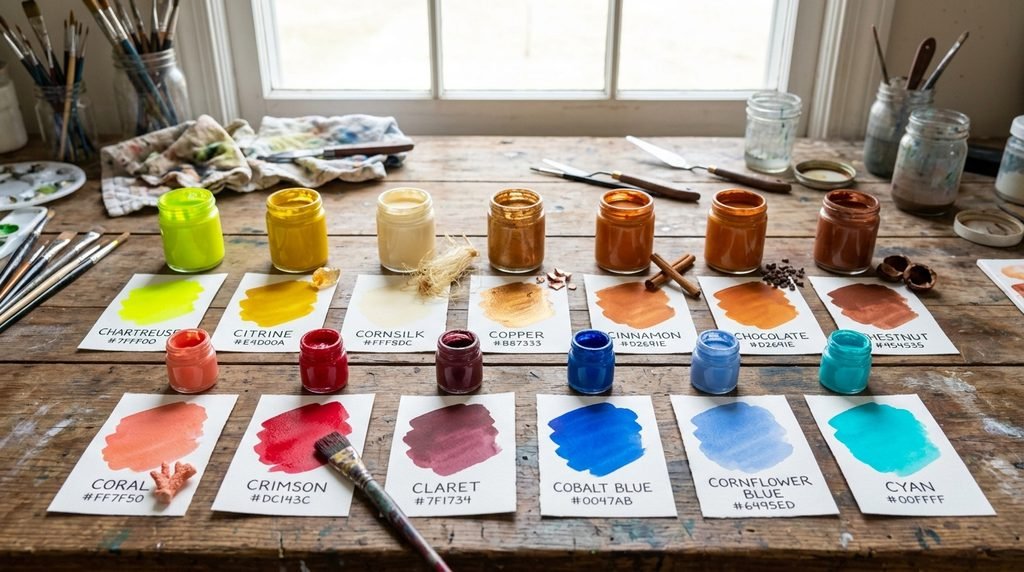
Chestnut
A warm, reddish brown named after the nut’s shell, cozier and less orange than Copper. It leans closer to Auburn than to Chocolate, with a softer, more muted finish.
Hex: #954535 | RGB: 149, 69, 53 | CMYK: 0, 54, 64, 42
Chocolate
A rich, medium-dark brown that is also the official CSS/X11 color keyword. Despite the name, it reads more orange-brown than the color of an actual chocolate bar, which tends to run darker.
Hex: #D2691E | RGB: 210, 105, 30 | CMYK: 0, 50, 86, 18
Cinnamon
A warm, reddish-orange brown named for the spice. Worth noting directly: this shade shares the same Hex code as Chocolate above, since both color-naming traditions converged on #D2691E independently.
Hex: #D2691E | RGB: 210, 105, 30 | CMYK: 0, 50, 86, 18
Citrine
A deep, golden yellow named after the gemstone, which itself takes its name from the citron fruit. It carries more weight and warmth than Canary Yellow, leaning toward amber rather than lemon.
Hex: #E4D00A | RGB: 228, 208, 10 | CMYK: 0, 9, 96, 11
Claret
A dark, dusty red-purple named after a style of red Bordeaux wine. It’s more subdued than Carmine, with enough purple mixed in to read almost like a bruised plum.
Hex: #7F1734 | RGB: 127, 23, 52 | CMYK: 0, 82, 59, 50
Cobalt Blue
A vivid, highly saturated blue named after the metallic element used to produce the pigment. It’s brighter and more primary than Cerulean, with almost no green pulling it off course.
Hex: #0047AB | RGB: 0, 71, 171 | CMYK: 100, 58, 0, 33
Coral
A warm blend of pink and orange named after the marine coral it resembles. It’s the official CSS keyword for this shade, and it sits squarely between a sunset and a seashell.
Hex: #FF7F50 | RGB: 255, 127, 80 | CMYK: 0, 50, 69, 0
CornflowerBlue
A soft, medium blue named after the wildflower, gentler and more pastel than Cobalt or Capri. It was one of the original CSS color keywords and remains a go-to for calm, approachable interfaces.
Hex: #6495ED | RGB: 100, 149, 237 | CMYK: 58, 37, 0, 7
Cornsilk
A pale, warm cream named after the silky threads found on an ear of corn. It’s lighter and less pink than Champagne, closer to the color of raw paper.
Hex: #FFF8DC | RGB: 255, 248, 220 | CMYK: 0, 3, 14, 0
Copper
A bright, brassy orange-brown named after the metal, with a slight reddish glow that separates it from flat brown. It reads as more polished and metallic than Chestnut.
Hex: #B87333 | RGB: 184, 115, 51 | CMYK: 0, 38, 72, 28
Crimson
A deep, slightly blue-leaning red, one of the official CSS keywords and one of the oldest documented color names in English. It’s darker and more serious than Coral, with real weight behind it.
Hex: #DC143C | RGB: 220, 20, 60 | CMYK: 0, 91, 73, 14
Cyan
A pure, saturated blue-green, one of the three primary colors in the CMYK printing model and a standard CSS keyword. In code, Cyan and Aqua point to the same Hex value.
Hex: #00FFFF | RGB: 0, 255, 255 | CMYK: 100, 0, 0, 0
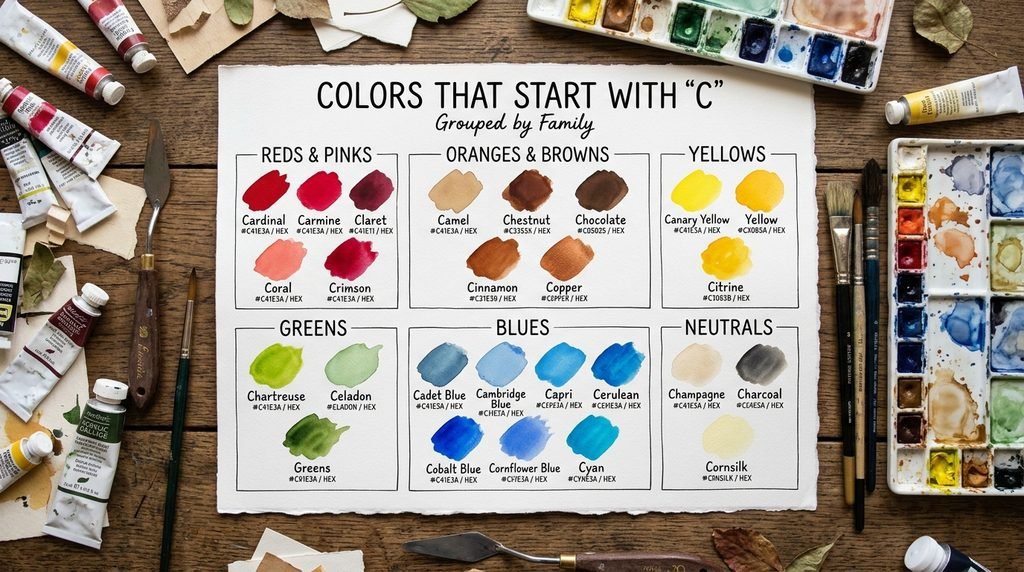
Colors That Start With C, Grouped by Family
The table below sorts every color in this guide into six broad families, so you can browse by mood instead of alphabet. Reds and pinks carry warmth and urgency, while the blues range from pastel calm to fully saturated and electric. Use this table as a starting point when you know the feeling you want but haven’t picked the exact shade yet.
| Family | Colors |
| Reds & Pinks | Cardinal, Carmine, Claret, Coral, Crimson |
| Oranges & Browns | Camel, Chestnut, Chocolate, Cinnamon, Copper |
| Yellows | Canary Yellow, Citrine |
| Greens | Chartreuse, Celadon |
| Blues | Cadet Blue, Cambridge Blue, Capri, Cerulean, Cobalt Blue, Cornflower Blue, Cyan |
| Neutrals | Champagne, Charcoal, Cornsilk |
Blues dominate this list more than any other family, which makes sense given how many natural and mineral references start with C, from cobalt ore to Capri’s coastline. Reds and browns are close behind, both pulling heavily from food, gemstones, and dye history. Yellows and greens are the most sparsely populated families here, which is simply a reflection of how few well-documented C names fall into those hues.
How to Read Hex, RGB, and CMYK Codes
These three formats describe the same color in three different ways, and which one you need depends entirely on where the color is going. Hex codes, the six-digit values like #D2691E, are built for screens and are what you’ll paste into CSS, Figma, or any web-based design tool. RGB breaks that same value into three numbers, one each for red, green, and blue light, which is useful when a tool wants sliders instead of a code.
CMYK is different because it describes ink, not light, which is why it’s the format printers ask for. It uses four values, cyan, magenta, yellow, and black (K), and the ratios shift because ink and screen light behave differently. If you only remember one rule, remember this: use Hex or RGB for anything that will be viewed on a screen, and convert to CMYK only when a file is heading to a printer.
How to Use These Colors
In Graphic Design
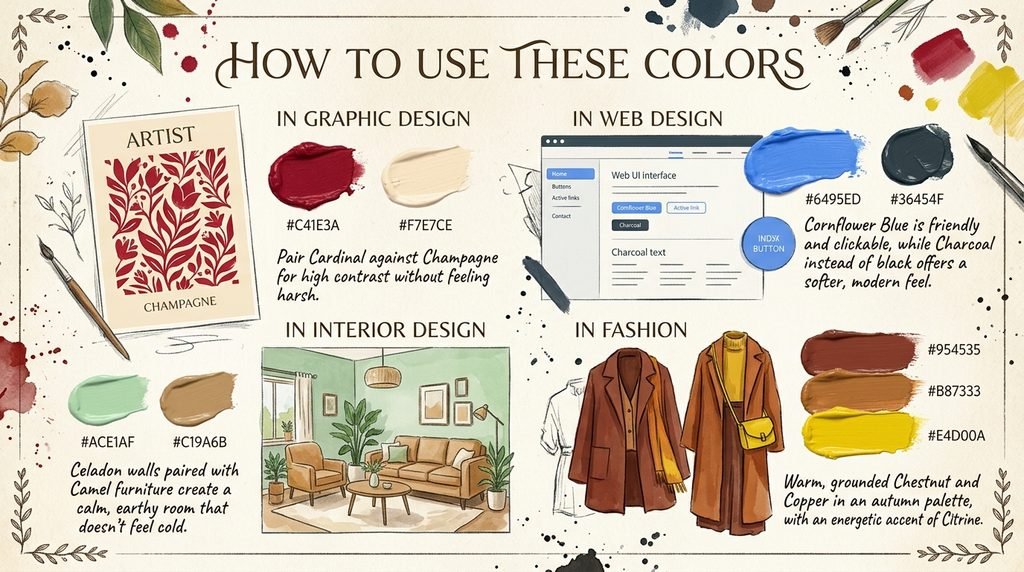
Pair a saturated anchor color with a muted neutral so the palette doesn’t fight itself. Cardinal (#C41E3A) against Champagne (#F7E7CE) gives a poster real contrast without feeling harsh, since the pale background lets the red do all the work.
In Web Design
Cornflower Blue (#6495ED) is a reliable choice for buttons and links, since it reads as friendly and clickable without the intensity of Cobalt Blue. Pair it with Charcoal (#36454F) text instead of pure black for a softer, more modern feel.
In Interior Design
Celadon (#ACE1AF) walls paired with Camel (#C19A6B) furniture create a calm, earthy room that avoids feeling cold. Both colors are muted enough to coexist without one overpowering the other.
In Fashion
Chestnut (#954535) and Copper (#B87333) work well together in an autumn palette, since both carry warmth without clashing. Add a small accent of Citrine (#E4D00A) in an accessory, and the whole look gains energy without losing its grounded feel.
Conclusion
From the electric brightness of Chartreuse to the quiet depth of Charcoal, colors that start with C cover nearly every mood a designer could ask for. This list of 24 verified names gives you real Hex, RGB, and CMYK values to work from, whether you’re building a screen palette or sending a file to print. Explore our color tool to test these shades together before you commit to a final palette.
FAQs
What are some popular colors that start with C?
Crimson, Coral, Cobalt Blue, Charcoal, and Champagne are among the most widely recognized. Each has a standardized Hex code, so they render consistently across design software.
What is the darkest color that starts with C?
Charcoal (#36454F) is the darkest neutral on this list, while Carmine (#960018) is the darkest true color, with a CMYK black value of 41%.
What is the brightest color that starts with C?
Chartreuse (#7FFF00) and Cyan (#00FFFF) are the most saturated entries, both sitting at full brightness with zero black (K) in their CMYK values.
Are Cinnamon and Chocolate the same color?
Technically, yes. Both names are documented as #D2691E across multiple independent sources, even though they’re usually marketed as separate, spice- and food-inspired names.
What’s the difference between Cyan and Cerulean?
Cyan (#00FFFF) is a pure, maximum-saturation blue-green and one of the three CMYK primary colors. Cerulean (#007BA7) is darker and more muted, closer to the color of open seawater than a screen-perfect primary.
Which colors that start with C work well for print projects?
Any color on this list works for print once converted to CMYK, but Cornsilk (#FFF8DC) and Champagne (#F7E7CE) are especially popular for print backgrounds, since their CMYK values use very little ink.
What is a good C color for a calming space?
Celadon (#ACE1AF) and Cambridge Blue (#A3C1AD) are both muted, low-saturation shades often used in wellness and spa-style interiors.