Colors That Start With B: Unique Shades, Names & Codes
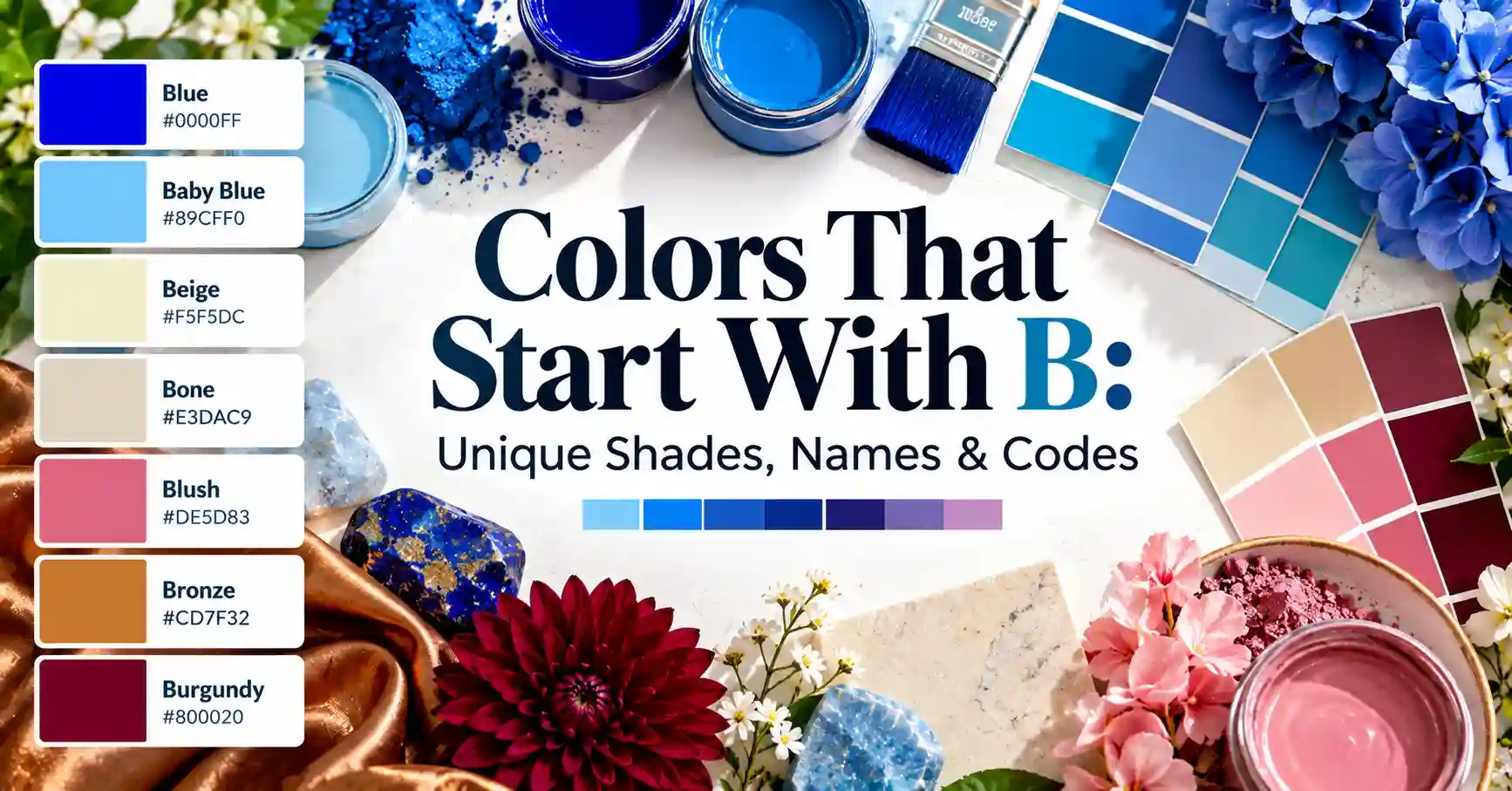
Colors that start with B span a surprising range. You get soft pastels like Baby Blue, deep wine tones like Burgundy, and even a color named after an ancient empire. This guide gathers the names with real, stable hex codes, skipping anything that only exists on a single paint brand’s chart.
The list is organized three ways. First, colors sit in family groups, so pinks stay with pinks and browns stay with browns. Next comes a sort by use case, covering branding, fashion, and nature-inspired names. Last is a full alphabetical list with three tables, so you can look up a code fast once you know the name.
Different people reach for a guide like this for different reasons. A designer needs an exact code before a logo ships. A painter wants one shared name for a wall color instead of describing it from scratch. Parents sometimes browse lists like this for a nursery theme or a pet name, and trivia fans enjoy the odd stories, like a color named after a 1964 psychology experiment.
This list runs shorter than some you’ll find elsewhere, and that is deliberate. Many “B” color lists pad their count with brand-only paint names, and those hex codes shift depending on the maker. We kept names whose codes held steady across at least two sources. Where sources disagreed, that gets flagged directly rather than hidden.
Quick Answer: The Standout B Colors
Start with Burgundy (#800020), a deep wine red tied to the French wine region of the same name. Bronze (#CD7F32) brings a metallic warmth borrowed from the copper-tin alloy. Baby Blue (#89CFF0) and Baby Pink (#F4C2C2) cover the softest end of the palette, both tracing back to early 20th-century nursery traditions.
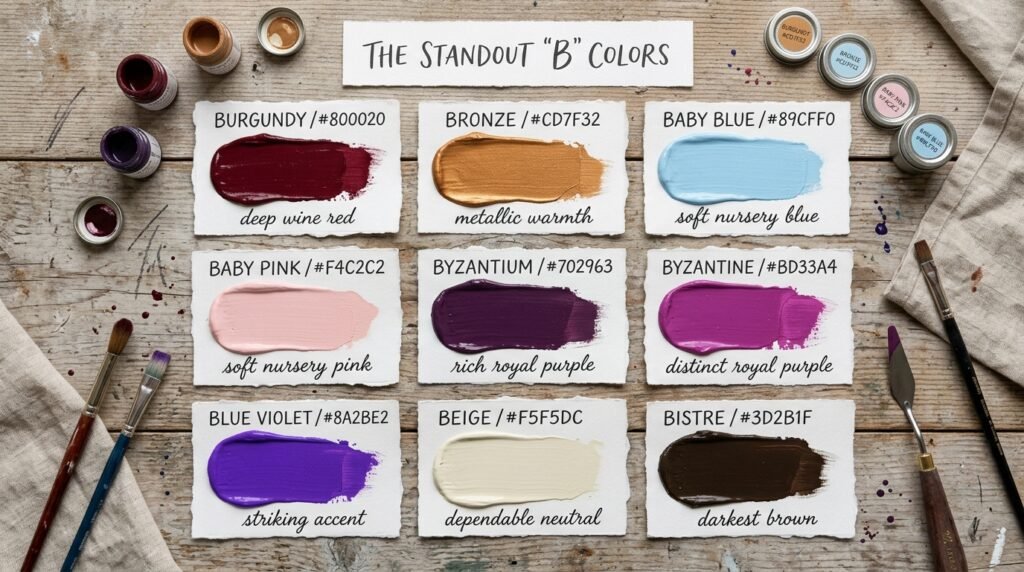
Caption: Nine standout B colors, ranging from deep Burgundy to soft Baby Blue.
For something bolder, Byzantium (#702963) and Byzantine (#BD33A4) both channel royal purple, though they are two distinct shades despite the similar names. Blue Violet (#8A2BE2) sits between primary colors for a striking accent. Round it out with Beige (#F5F5DC) for a dependable neutral and Bistre (#3D2B1F) for the darkest brown on the list.
What B Colors Mean and Evoke
Burgundy carries weight. It is named after wine, so it signals richness, maturity, and a touch of indulgence. Designers reach for it when a brand needs to feel established rather than playful. Bronze works in a similar register, but through metal instead of drink. It recalls awards, antiques, and craftsmanship, which is why third-place medals use it.
Baby Blue and Baby Pink carry a gentler story. Between 1930 and 1950, these two became the standard “baby colors” in Western culture, showing up on birth announcements and in baby books. That history still shapes how people read them today, as soft, innocent, and tied to early childhood.
Byzantium and Byzantine both borrow from the same historical source, the Byzantine Empire, known for opulent purple dye reserved for royalty. Both colors inherit that association with luxury and exclusivity, even though they land in slightly different places on the color wheel. Black, meanwhile, needs no borrowed story. It reads as authority, elegance, or mystery depending entirely on context, which is why it remains the most flexible color in design.
B. Colors Grouped by Family
Blues. Baby Blue (#89CFF0), Blue (#0000FF), and Blue Violet (#8A2BE2) make up this group. They range from a barely-there pastel to the fully saturated primary blue, with Blue Violet pulling toward purple at the edge. This spread makes the blue family useful across very different moods, from calm nurseries to bold accent work.
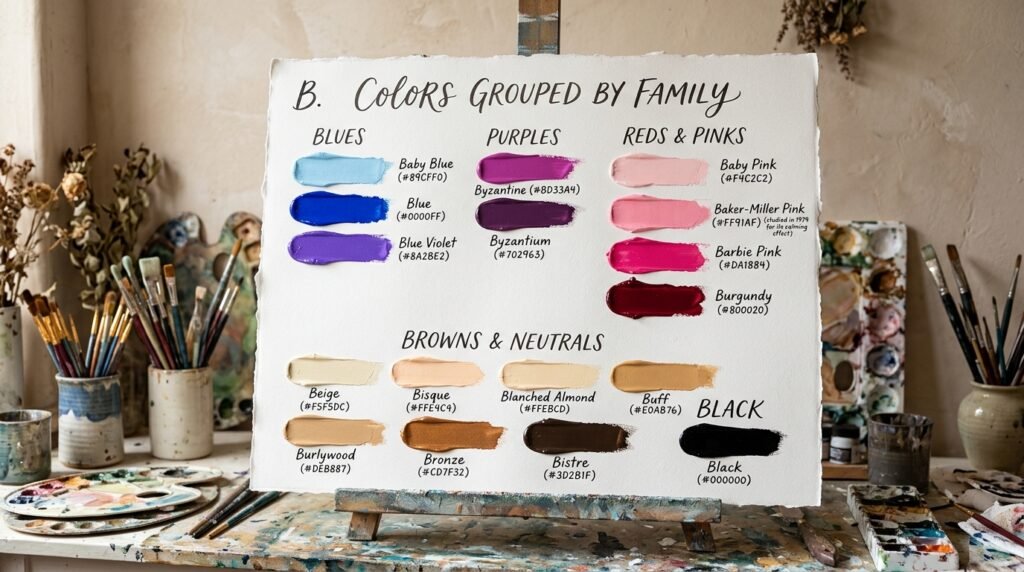
Caption: B colors split into five families, from pale blues to the deepest browns.
Purples. Byzantium (#702963) and Byzantine (#BD33A4) sit here, both rich and historically loaded. Byzantium is the darker, more subdued of the two, while Byzantine runs brighter and more magenta-leaning.
Reds and pinks. Baby Pink (#F4C2C2), Baker-Miller Pink (#FF91AF), Barbie Pink (#DA1884), and Burgundy (#800020) cover a wide range, from the softest pastel to a bold, saturated wine red. Baker-Miller Pink stands out here for a reason beyond color: it was studied for its supposed calming effect in a 1979 psychology experiment.
Browns and neutrals. This is the largest B group. Beige (#F5F5DC), Bisque (#FFE4C4), Blanched Almond (#FFEBCD), Bistre (#3D2B1F), Bronze (#CD7F32), Buff (#E0AB76), and Burlywood (#DEB887) all share warm, muted undertones. They range from a nearly white sand tone to a near-black coffee brown.
Black. Black (#000000) stands alone as the only true neutral extreme in the B list, with no color value at all.
Design and Branding Favorites Among Shades of B Colors
Burgundy shows up constantly in branding that wants to feel established, from wine labels to law firm logos, since the color borrows credibility straight from its namesake. Bronze does similar work in a different register, often used for awards, finance, and anything that wants to suggest heritage without looking dated. Black remains the default choice when a brand wants maximum flexibility, since it pairs cleanly with nearly every other color on this list.

The table below lists four B colors that come up often in branding work, with a typical use for each.
| Color | Hex | Typical Use |
| Burgundy | #800020 | Wine labels, law firms, luxury branding |
| Bronze | #CD7F32 | Awards, finance, heritage branding |
| Black | #000000 | Logos, typography, premium packaging |
| Baby Blue | #89CFF0 | Healthcare, nurseries, soft tech branding |
Of these four, Black does the most universal work, since it functions as both a primary color and a neutral depending on context. Burgundy and Bronze are narrower but stronger, both tied closely to a specific, established mood.
Fashion and Beauty Shades With B Color Names
Fashion leans hard on the B list for both pastel and bold work. Baby Pink and Baby Blue anchor countless spring collections, prized for how easily they pair with nearly any other color. Burgundy moves things into autumn and winter, a staple for lipstick, nail polish, and outerwear when a season calls for depth. Barbie Pink, a sharper, more saturated shade than Baby Pink, became shorthand for bold, unapologetic color choices well before the 2023 film brought it back into the spotlight.
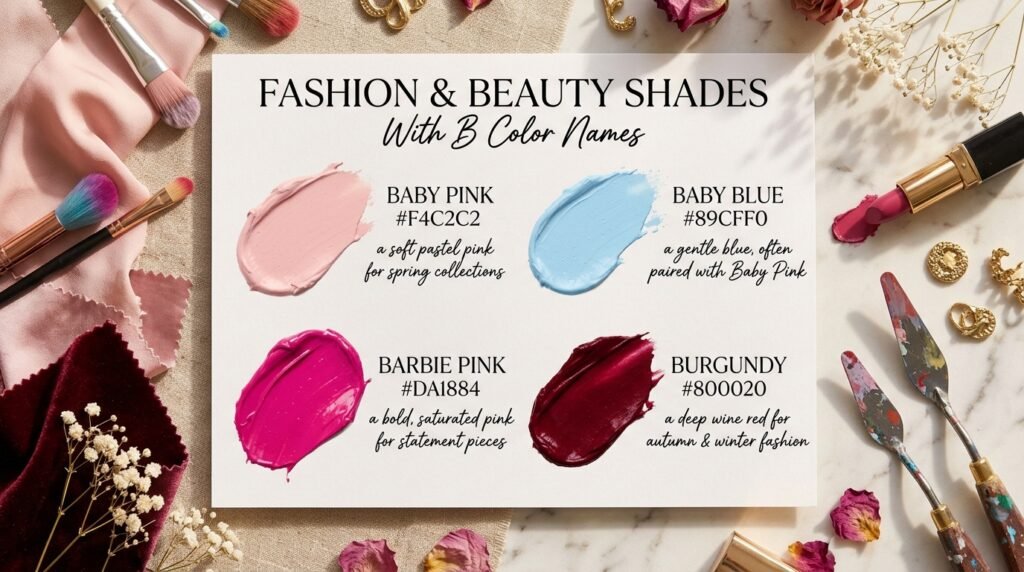
- Baby Pink (#F4C2C2): a soft pastel pink for spring collections
- Baby Blue (#89CFF0): a gentle blue, often paired with Baby Pink
- Barbie Pink (#DA1884): a bold, saturated pink for statement pieces
- Burgundy (#800020): a deep wine red for autumn and winter fashion
Notice how far apart Baby Pink and Barbie Pink sit despite sharing a name root. One stays soft and nursery-adjacent, while the other reads as loud and confident. That gap makes them useful as contrast pieces within the same collection.
Nature-Inspired B Color Names
A handful of B colors trace back to something physical. Bronze borrows directly from the copper-tin alloy, and the color keeps that same warm, metallic glow even when used digitally. Buff comes from buff leather, specifically the undyed hide once used in military uniforms, first recorded as a color name in a 1686 London Gazette description. Bistre has an even older, messier origin. It was traditionally made from the soot of burnt wood, which is why it reads as a warm, slightly reddish dark brown rather than a flat black-brown.
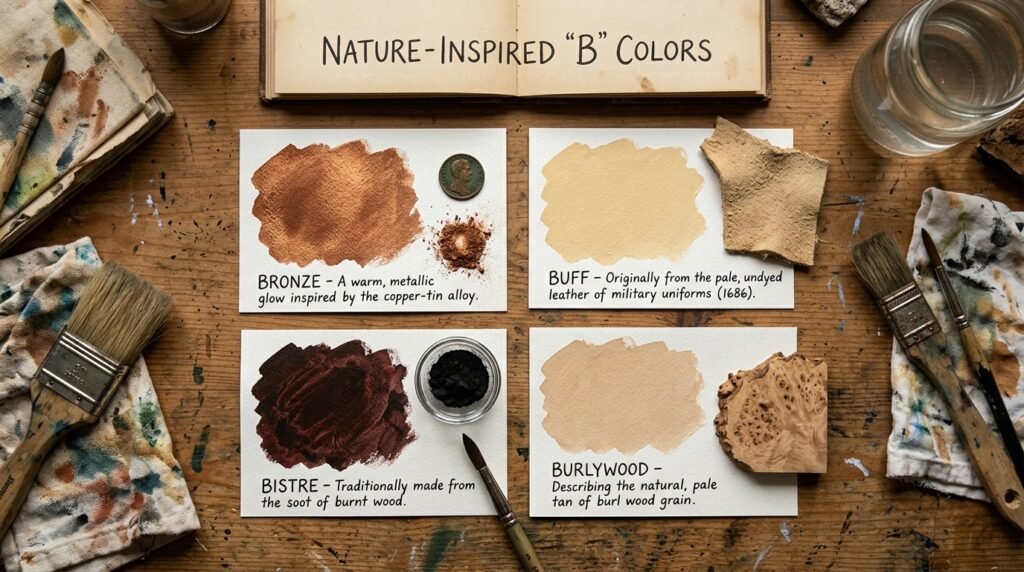
Burlywood rounds out the group with a more literal name, describing the pale tan color of burl wood grain used in furniture.
Rare or Unusual B Color Names
A few B names carry stranger backstories than their simple appearance suggests. Baker-Miller Pink is the most unusual entry on this entire list. Named after two U.S. Navy officers, it was tested in a 1979 study for its supposed ability to reduce aggression when painted on prison holding-cell walls, which is why it is sometimes still called “drunk tank pink.” Byzantine and Byzantium, despite looking like variations of the same word, are two genuinely different colors, both drawing on the historic empire’s association with royal purple dye.
Bistre is unusual for a different reason. It is one of the oldest documented pigment names on the list, originally a brown ink made from wood soot rather than a mineral or plant source. Blanched Almond rounds things out as an oddly specific CSS name, describing the pale, toasted color of an almond with its skin removed.
- Baker-Miller Pink (#FF91AF): studied for a calming effect in prison cells
- Byzantine (#BD33A4): a bright magenta-purple named after the empire
- Bistre (#3D2B1F): an old pigment name, originally made from wood soot
- Blanched Almond (#FFEBCD): a CSS name for a pale, skinless almond tone
Between these four, Baker-Miller Pink has by far the most documented, peer-reviewed backstory, which is rare for a color name that otherwise looks like an ordinary pastel pink.
B Colors That Are Easily Confused
The most confusing pair on this list is Byzantium and Byzantine. Byzantium (#702963) is the darker, more muted of the two, while Byzantine (#BD33A4) is brighter and leans harder into magenta. Beyond that pair, Baby Blue and Baby Pink sometimes get mixed up in casual conversation, even though they sit on opposite sides of the color wheel and share nothing but a cultural association. Beige, Bisque, and Blanched Almond also blur together, since all three are pale, warm neutrals with only subtle differences in undertone.
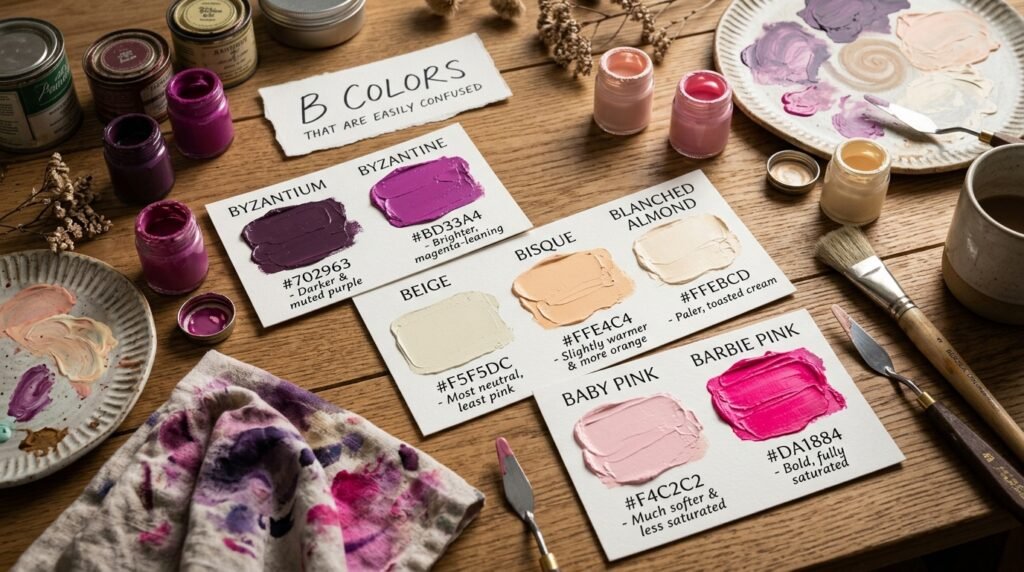
The table below lists the pairs most likely to confuse, along with the key difference to check before you commit to one.
| Name | Hex | Easily Confused With | Key Difference |
| Byzantium | #702963 | Byzantine | Darker and more muted purple |
| Byzantine | #BD33A4 | Byzantium | Brighter, leans toward magenta |
| Beige | #F5F5DC | Bisque, Blanched Almond | Most neutral, least pink |
| Bisque | #FFE4C4 | Beige, Blanched Almond | Slightly warmer and more orange |
| Blanched Almond | #FFEBCD | Bisque | Paler, closer to a toasted cream |
| Baby Pink | #F4C2C2 | Barbie Pink | Much softer and less saturated |
| Barbie Pink | #DA1884 | Baby Pink | Bold, fully saturated magenta-pink |
If a brief says “Byzantine purple,” confirm which of the two names they actually mean before starting work. The visual gap between them is wide enough to throw off an entire palette if you guess wrong.
Master Alphabetical List of B Colors
The list below puts every color in this guide in alphabetical order. Standard web colors are marked as CSS/X11, while the rest draw on traditional, well-documented sources. Brand-only paint names are left out, since their codes shift by manufacturer.
- Baby Blue — #89CFF0 (traditional, in use since 1892)
- Baby Pink — #F4C2C2 (traditional)
- Baker-Miller Pink — #FF91AF (named after a 1979 psychology study)
- Barbie Pink — #DA1884 (traditional/brand-associated name)
- Beige — #F5F5DC (CSS/X11 standard)
- Bisque — #FFE4C4 (CSS/X11 standard)
- Bistre — #3D2B1F (traditional, originally a wood-soot pigment)
- Black — #000000 (CSS/X11 standard)
- Blanched Almond — #FFEBCD (CSS/X11 standard)
- Blue — #0000FF (CSS/X11 standard)
- Blue Violet — #8A2BE2 (CSS/X11 standard)
- Bronze — #CD7F32 (traditional, named after the alloy)
- Brown — #A52A2A (CSS/X11 standard)
- Buff — #E0AB76 (traditional; sources vary slightly)
- Burgundy — #800020 (traditional, named after the wine region)
- Burlywood — #DEB887 (CSS/X11 standard)
- Byzantine — #BD33A4 (traditional)
- Byzantium — #702963 (traditional)
Eight of these are true CSS keywords: Beige, Bisque, Black, Blanched Almond, Blue, Blue Violet, Brown, and Burlywood. The rest need a manual hex code in any design tool.
Hex and RGB Crosswalk for B Color Names With Hex Codes
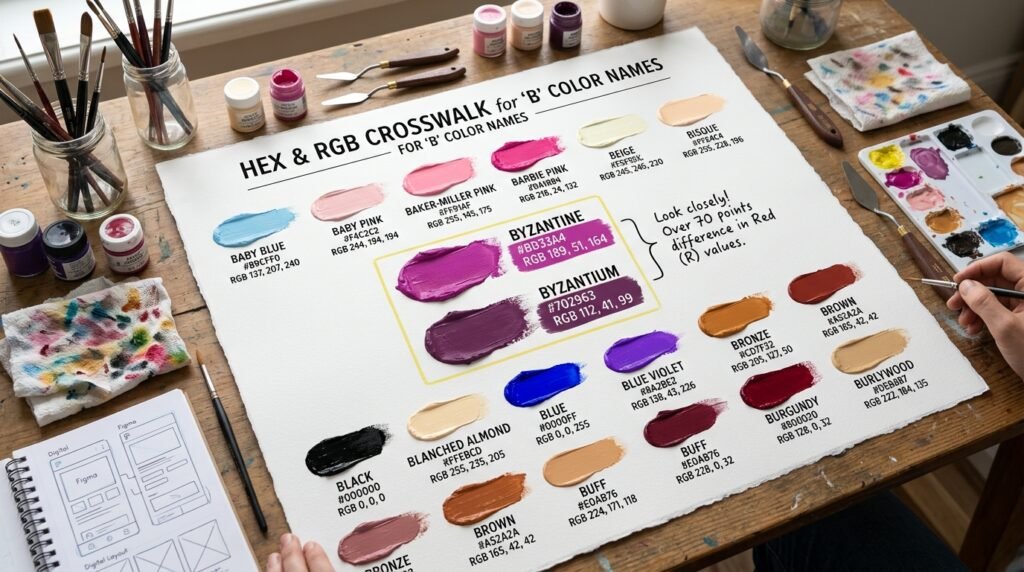
Exact codes matter because names alone leave too much room for guessing. “Byzantine” and “Byzantium” are a perfect example. They sound nearly identical, but their hex codes reveal two genuinely different colors. Web and app tools such as CSS and Figma usually want a hex code, while some print and video software default to RGB sliders. Keeping both on hand saves you a manual conversion mid-project.
| Color | Hex | RGB |
| Baby Blue | #89CFF0 | 137, 207, 240 |
| Baby Pink | #F4C2C2 | 244, 194, 194 |
| Baker-Miller Pink | #FF91AF | 255, 145, 175 |
| Barbie Pink | #DA1884 | 218, 24, 132 |
| Beige | #F5F5DC | 245, 245, 220 |
| Bisque | #FFE4C4 | 255, 228, 196 |
| Bistre | #3D2B1F | 61, 43, 31 |
| Black | #000000 | 0, 0, 0 |
| Blanched Almond | #FFEBCD | 255, 235, 205 |
| Blue | #0000FF | 0, 0, 255 |
| Blue Violet | #8A2BE2 | 138, 43, 226 |
| Bronze | #CD7F32 | 205, 127, 50 |
| Brown | #A52A2A | 165, 42, 42 |
| Buff | #E0AB76 | 224, 171, 118 |
| Burgundy | #800020 | 128, 0, 32 |
| Burlywood | #DEB887 | 222, 184, 135 |
| Byzantine | #BD33A4 | 189, 51, 164 |
| Byzantium | #702963 | 112, 41, 99 |
Look closely at the Byzantine and Byzantium rows. Their red values differ by over 70 points, which explains why one reads as a muted plum and the other as a bright magenta-purple. That single number carries most of the visual difference between them.
Full Comparison Table of B Colors
This table brings everything together: each color’s name, hex, RGB, family, and a common use. Treat it as a working reference when you need to justify a choice or double-check a value before sending a file to print.
| Color | Hex | RGB | Family | Common Use |
| Baby Blue | #89CFF0 | 137,207,240 | Blue | Nurseries, healthcare, soft branding |
| Blue | #0000FF | 0,0,255 | Blue | Primary accents, tech branding |
| Blue Violet | #8A2BE2 | 138,43,226 | Blue/Purple | Bold accents, nightlife branding |
| Byzantium | #702963 | 112,41,99 | Purple | Luxury branding, regal themes |
| Byzantine | #BD33A4 | 189,51,164 | Purple/Magenta | Bold fashion, event branding |
| Baby Pink | #F4C2C2 | 244,194,194 | Pink | Spring fashion, nurseries |
| Baker-Miller Pink | #FF91AF | 255,145,175 | Pink | Calming environments, wellness branding |
| Barbie Pink | #DA1884 | 218,24,132 | Pink | Bold fashion, youth branding |
| Burgundy | #800020 | 128,0,32 | Red | Wine labels, luxury, autumn fashion |
| Beige | #F5F5DC | 245,245,220 | Neutral | Interiors, minimalist branding |
| Bisque | #FFE4C4 | 255,228,196 | Neutral | Warm backgrounds, skin-tone palettes |
| Blanched Almond | #FFEBCD | 255,235,205 | Neutral | Soft backgrounds, bridal palettes |
| Bistre | #3D2B1F | 61,43,31 | Dark Brown | Packaging, vintage design |
| Bronze | #CD7F32 | 205,127,50 | Metallic Brown | Awards, finance, heritage branding |
| Brown | #A52A2A | 165,42,42 | Brown | Earthy interiors, autumn themes |
| Buff | #E0AB76 | 224,171,118 | Tan/Brown | Leather goods, military heritage |
| Burlywood | #DEB887 | 222,184,135 | Tan | Furniture, natural wood themes |
| Black | #000000 | 0,0,0 | Neutral | Typography, premium packaging |
A few rows stand out. Burgundy and Bronze both do heavy lifting in heritage and luxury branding, far beyond what their single entries suggest. Byzantium and Byzantine prove how much a few RGB points can change a color’s entire mood. And Black remains the quiet workhorse of the list, useful in almost any context regardless of which other B color it sits beside.
Which B Color Should You Pick? A Decision Guide
Use the table below to match a project type to a fitting B color. Start with your project in the left column, then check the suggested shade and the reason before locking in a final hex code.

| Project | Suggested Color | Why It Works |
| Wine or luxury branding | Burgundy (#800020) | Established, rich, directly tied to wine culture |
| Award or finance branding | Bronze (#CD7F32) | Suggests heritage and achievement |
| Nursery or baby shower | Baby Blue (#89CFF0) or Baby Pink (#F4C2C2) | Soft, traditional, gentle on the eyes |
| Calming interior or wellness space | Baker-Miller Pink (#FF91AF) | Studied for a documented calming effect |
| Bold fashion or youth branding | Barbie Pink (#DA1884) | High saturation, impossible to ignore |
| Premium packaging or typography | Black (#000000) | Maximum flexibility, pairs with anything |
| Furniture or natural wood branding | Burlywood (#DEB887) | Matches real wood grain tones |
For wall paint, always test a physical sample before committing. Screens render color differently depending on the display, so natural light at different times of day will tell you more than any hex code alone.
Conclusion
From soft Baby Blue to the deep historical weight of Byzantium, colors that start with B cover an unusually wide emotional range for one letter. You now have verified hex codes, clear family groups, and a guide for telling near-identical shades apart. Save the comparison table if you expect to return and check a code later, since it is the fastest way from a color name to a working value.
FAQ
What are the most common colors that start with B?
The most recognized are Black, Blue, Beige, Burgundy, Bronze, and Baby Blue. Black and Blue in particular show up constantly outside of design work, since both are among the oldest named colors in English.
What is the difference between Byzantium and Byzantine?
Byzantium (#702963) is darker and more muted, closer to plum. Byzantine (#BD33A4) is brighter and leans toward magenta. Both borrow their names from the same historical empire, but they are distinct colors.
What is the hex code for Burgundy?
Burgundy’s hex code is #800020, which is 128, 0, 32 in RGB. It is a dark, purplish red named after the Burgundy wine region in France.
Why is Baker-Miller Pink sometimes called “drunk tank pink”?
It was studied in 1979 for a supposed calming effect when painted on prison holding-cell walls. The nickname “drunk tank pink” comes from this early use in correctional facilities.
What is Bronze meant to represent?
Bronze (#CD7F32) is named after the copper-tin alloy of the same name. It carries associations with awards, antiques, and craftsmanship.
Is Buff a reliable, standardized color?
Buff is a traditional name rather than a fixed web standard, so different sources list slightly different hex values. We use #E0AB76 from Wikipedia’s color reference, but always confirm the exact shade with your specific source if precision matters.
What is the difference between Baby Blue and Baby Pink?
Baby Blue (#89CFF0) and Baby Pink (#F4C2C2) were both popularized as “baby colors” between 1930 and 1950. They sit on opposite sides of the color wheel and share only their cultural association, not their actual hue.