What Color Do Green and Black Make? Complete Mixing Guide
If you’ve ever wondered “green and black make what color,” you’re not alone. It’s a highly common question among home DIYers trying to choose the perfect accent wall, as well as landscape artists looking to capture the deep, moody shadows of a pine forest.
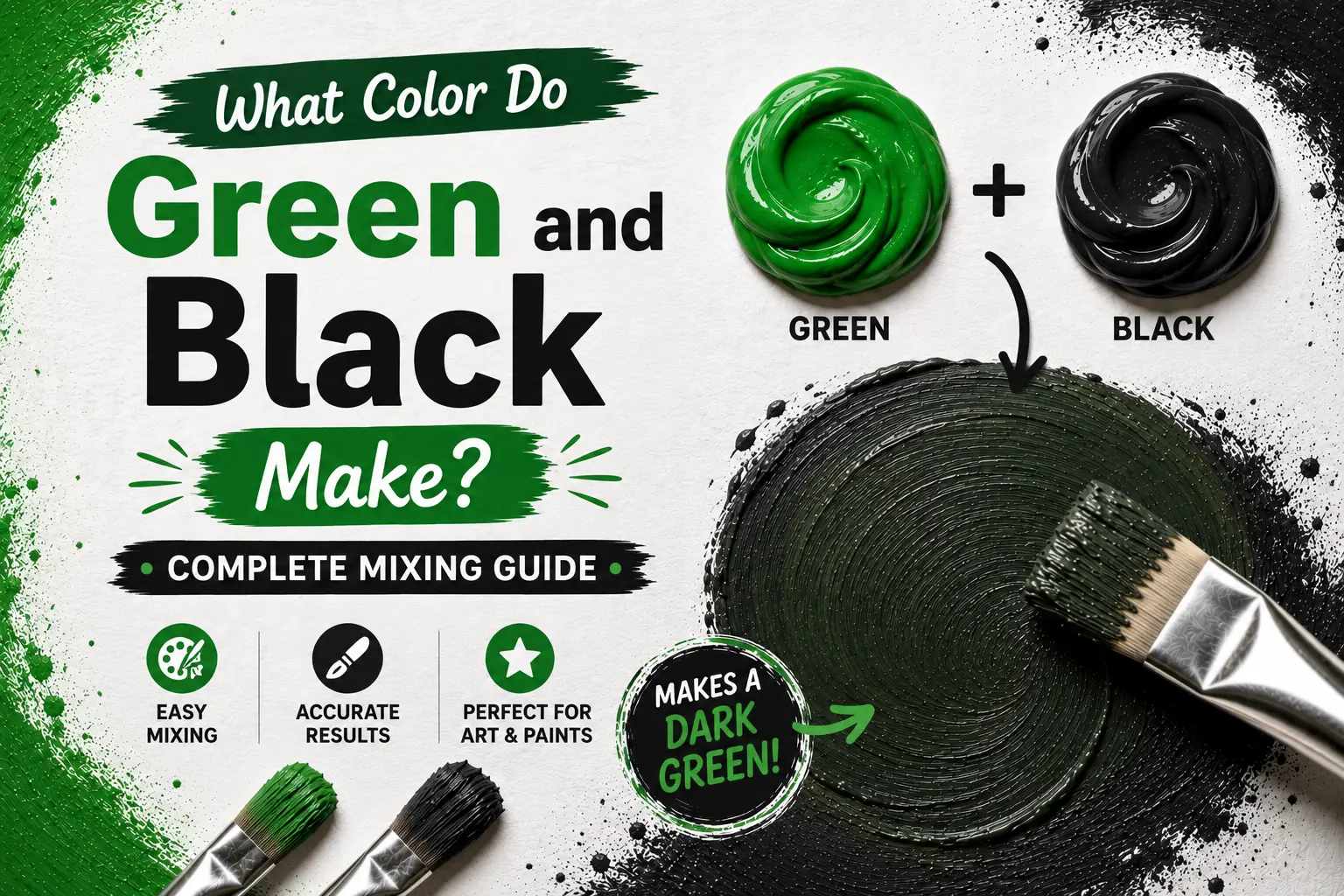
The direct answer is simple: mixing green and black together creates a deep, desaturated shade of dark green, often producing rich tones like forest green, olive green, or an intense “green-black.”
However, the final result isn’t always identical every single time you mix them. The exact color you get depends heavily on whether your base green is warm or cool, the type of black pigment you use, and the medium you are working with. Understanding how these colors interact gives you total control over creating natural shadows and moody palettes. In this guide, you’ll learn the exact color science behind this blend, how different paint pigments behave when crossed, and how to utilize these deep, natural shades across various creative mediums.
Main Takeaway:
Secondary Green + Neutral Black = Dark Green / Forest Green (varying in temperature and depth depending on your starting pigment ratios and undertones).
Mixing Green and Black in Paint
When you add black paint directly to a pool of green on your mixing tray, you are performing a classic color theory technique known as shading. It’s a quick way to tone down the blinding brightness of a vivid green.
How Black Affects Green
Why does this happen? The reason is simple: black pigment is highly efficient at absorbing light waves. When black enters a green base, it swallows up the bright light reflections, instantly lowering the color’s value (lightness) while muting its chroma (saturation).
Here’s a good example: if you take a bright, electric Kelly green and slowly swirl in a tiny drop of Lamp Black, the bright green softens instantly. It transitions away from a grassy tone and turns into a deep, atmospheric shadow green.
Color Theory Basics: How Green and Black Mix
To understand how this mixture behaves across different platforms, you need to look at how light wavelengths and physical pigments behave when they meet.
RYB Model (Traditional Paint Mixing)
In traditional art classes, we use the RYB (Red, Yellow, Blue) model. Because paint relies on subtractive mixing, adding pigments together filters out light. Since green is a mix of yellow and blue, adding black (which is often made from a combination of dark blue, red, and yellow pigments) absorbs almost all of the remaining light waves, pulling the mix down into a dense, organic dark green.
RGB Model (Digital Light)
Now compare that with digital displays, which operate on the additive RGB (Red, Green, Blue) model. Think of a phone screen: green is a pure primary light channel, while black is the absolute absence of light (all subpixels turned off). When you reduce the brightness value of your green subpixels in digital design software, you are “mixing” it with black, which lowers the screen’s output to create a clean, luminous dark green on display.
CMYK Model (Printing)
The CMYK (Cyan, Magenta, Yellow, Key/Black) system governs commercial printing and home inkjets. Because printer ink is transparent, layering Black (K) ink directly over a base of Green (made from Cyan and Yellow) absorbs light on the paper. This subtractive process must be carefully balanced, or the heavy black ink will oversaturate the paper and turn your crisp design into a muddy, unrecognizable dark blob.
Core Results: What Color Do Green and Black Make?
The balance of your mixture determines the exact kind of deep neutral you will create on your palette.
Let’s look at how simple changes in your starting green pigment alter the final output:
Olive Green
If your base green leans heavily toward yellow (like a bright Chartreuse or warm grass green), adding a touch of black will yield a gorgeous, earthy olive green. The black neutralizes the yellow’s high energy, leaving behind a warm, military-style khaki shade.
Forest Green
If you start with a balanced, true green (like a classic Emerald) and introduce black, you will create a rich, classic forest green. This shade mimics the deep, majestic evergreen needles found in natural pine forests.
Greenblack (Bottle Green)
What if you use more black? If you push your mixing ratio to nearly 80% black and 20% green, you create a deep, mysterious hue known as greenblack or “bottle green.” This is an incredibly sophisticated, near-black shade that reveals its dark green undertone only when caught by direct light.
Tints and Shades of Green and Black
Adjusting the value and visual temperature of your dark green mix allows you to customize the color’s final personality.
Lightening the Mix (Adding White or Yellow)
If your dark green mix looks a little too dark or muddy, you can easily open it back up. Adding a splash of white paint turns the heavy dark green into a soft, cool sage or slate gray-green. Alternatively, folding in a drop of warm yellow will lift the color while keeping it rich and organic, steering it toward a warm moss shade.
Darkening the Mix (Adding More Black)
If you want to pull your mixture further into the shadows, slowly introduce more black paint. To keep the color from looking lifeless and flat, artists often add a tiny pinpoint of Ultramarine Blue along with the black to give the dark green a cool, deep undercurrent.
Tints & Shades of Green and Black (with HEX Codes)
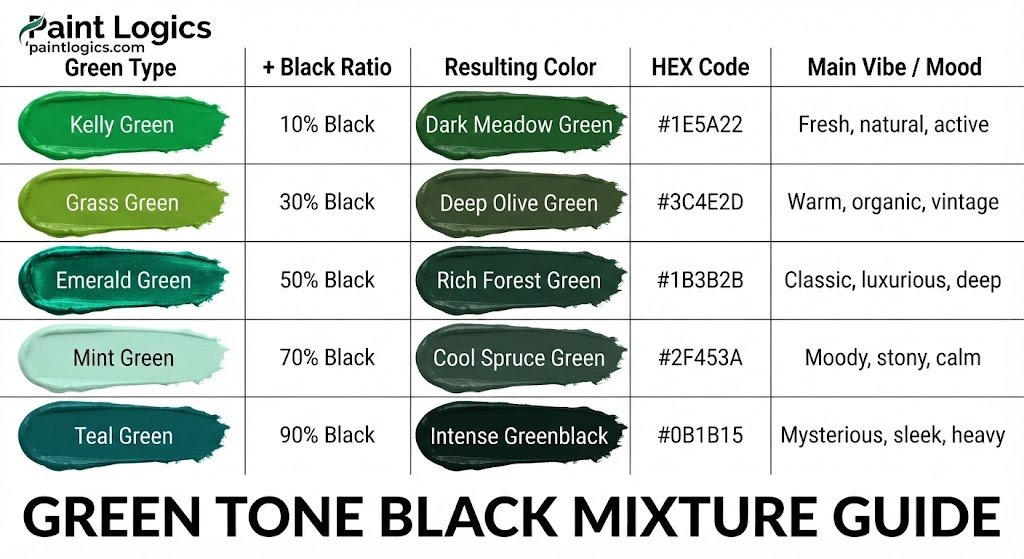
To help you plan your projects, here is a quick-reference chart displaying the visual spectrum of green and black blends:
| Green Type | Black Ratio | Expected Color | HEX Code | Main Vibe / Mood |
| Kelly Green | 10% Black | Dark Meadow Green | #1E5A22 | Fresh, natural, active |
| Grass Green | 30% Black | Deep Olive Green | #3C4E2D | Warm, organic, vintage |
| Emerald Green | 50% Black | Rich Forest Green | #1B3B2B | Classic, luxurious, deep |
| Mint Green | 70% Black | Cool Spruce Green | #2F453A | Moody, stony, calm |
| Teal Green | 90% Black | Intense Greenblack | #0B1B15 | Mysterious, sleek, heavy |
Pro Tip: Never mix pure black paint directly into a light green if you are trying to paint soft shadows. Instead, mix a tiny drop of your shadow green on a separate part of your palette first, then blend it slowly into your main area to keep from overwhelming your light tones.
Practical Uses for Green and Black Mixes in Art and Design
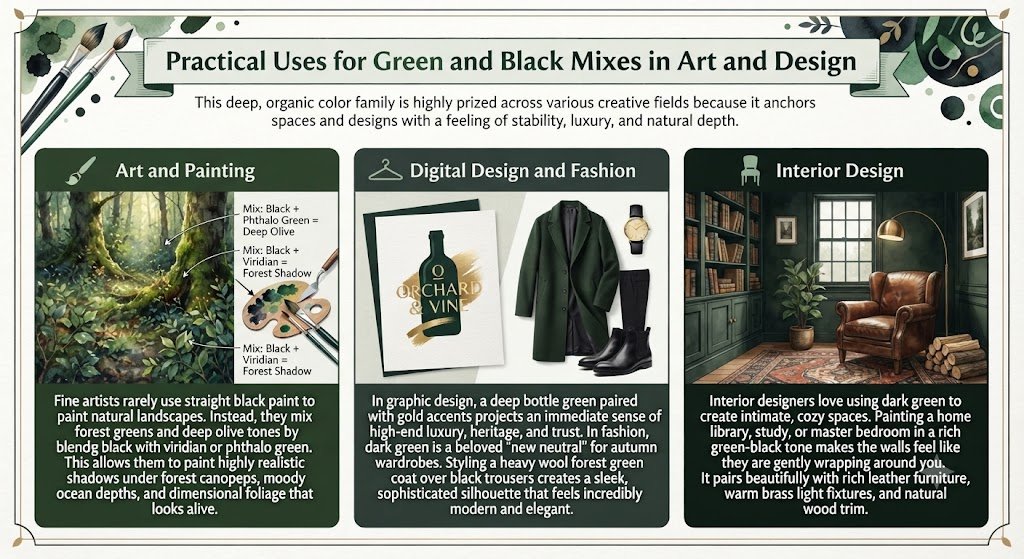
This deep, organic color family is highly prized across various creative fields because it anchors spaces and designs with a feeling of stability, luxury, and natural depth.
Art and Painting
Fine artists rarely use straight black paint to paint natural landscapes. Instead, they mix forest greens and deep olive tones by blending black with viridian or phthalo green. This allows them to paint highly realistic shadows under forest canopies, moody ocean depths, and dimensional foliage that looks alive.
Digital Design and Fashion
In graphic design, a deep bottle green paired with gold accents projects an immediate sense of high-end luxury, heritage, and trust. In fashion, dark green is a beloved “new neutral” for autumn wardrobes. Styling a heavy wool forest green coat over black trousers creates a sleek, sophisticated silhouette that feels incredibly modern and elegant.
Interior Design
Interior designers love using dark green to create intimate, cozy spaces. Painting a home library, study, or master bedroom in a rich green-black tone makes the walls feel like they are gently wrapping around you. It pairs beautifully with rich leather furniture, warm brass light fixtures, and natural wood trim.
Real-World Examples of Green and Black Mixing
Think of a dense pine forest on a cloudy day. The areas where the branches overlap don’t look pitch black; instead, they display a rich, deep forest green shadow.
Another great example is British Racing Green—the iconic, sophisticated color used on vintage sports cars. It’s a carefully balanced mix of deep green toned down with black pigments to give the vehicle a sleek, low-profile, and highly premium look on the track.
Conclusion: What Color Do Green and Black Make?
To bring it all home, green and black make dark green when mixed. By combining these two shades, the black paint acts as a natural light filter, lowering the green’s brightness to produce gorgeous, organic shades like forest green, olive green, and deep green-black.
The entire secret to mastering this classic mix lies in starting with your green paint as your main base, introducing your black pigment in tiny, controlled steps, and keeping your starting green’s undertones in mind. Whether you are painting a misty mountain landscape, updating your home’s interior, or building a high-end brand identity, utilizing this rich, moody color family adds instant sophistication, depth, and organic balance to your creative projects.
You Might Also Like:
- Black and White Make What Color? Gray Mixing Guide
- What Color Do Red, Green & Blue Make? RGB Explained Simply
FAQs
What is the difference between olive green and forest green when mixing green and black?
The difference comes down to the undertones of your starting green. Olive green is made by mixing black with a yellow-leaning, warm green, while forest green is created by mixing black with a balanced, neutral or blue-leaning green.
What color do you get if you mix green, black, and white?
Mixing green, black, and white together creates a beautiful, muted gray-green shade, often referred to as sage green, slate green, or eucalyptus.
How do I create an even darker shade of green?
To go even darker, add more black paint to your mix. If you want the color to look deep and rich rather than muddy, fold in a tiny pinpoint of Ultramarine Blue or Prussian Blue along with the black.
Can green and black create blue?
No. Green contains yellow and blue, and black is a neutral dark shade. Because there is no way to remove the yellow pigment from the green, mixing it with black will keep it firmly in the dark green or olive family and cannot make a pure blue.
Can I use green and black in digital designs?
Yes, absolutely! The combination of dark forest green and deep black creates a highly sophisticated, modern, and luxurious color scheme that is perfect for editorial websites, luxury packaging, and high-end branding.
What colors mixed together create dark green?
You can create a beautiful dark green by mixing primary blue and yellow together to make a base green, and then adding a small touch of black or a dark red (its complementary color) to deepen the shade.
What color does dark green and black make?
Mixing an already dark green with black will simply deepen the shade further, driving the mixture into an ultra-dark, near-black tone often called bottle green or “greenblack.”
How do I make dark green using green and black?
Start with a generous pool of your favorite green paint on your palette, then use your brush to drag a tiny, pinpoint-sized drop of black paint into the green. Mix thoroughly, adding micro-amounts of black until you reach your target shade.
What colors mixed together make dark green?
To get a rich dark green without using black paint, you can mix a classic primary blue with a small amount of primary yellow, and then add a tiny touch of deep red or burnt umber to desaturate and darken the mix naturally.
Does mixing green and black make brown?
No, mixing pure green and black will not make brown. However, if your green is highly warm and yellow-heavy (like a lime or olive), adding a heavy amount of black can sometimes mimic a very dark, swampy greenish-brown.